

Grey Willow - Salix cinerea subsp. cinerea
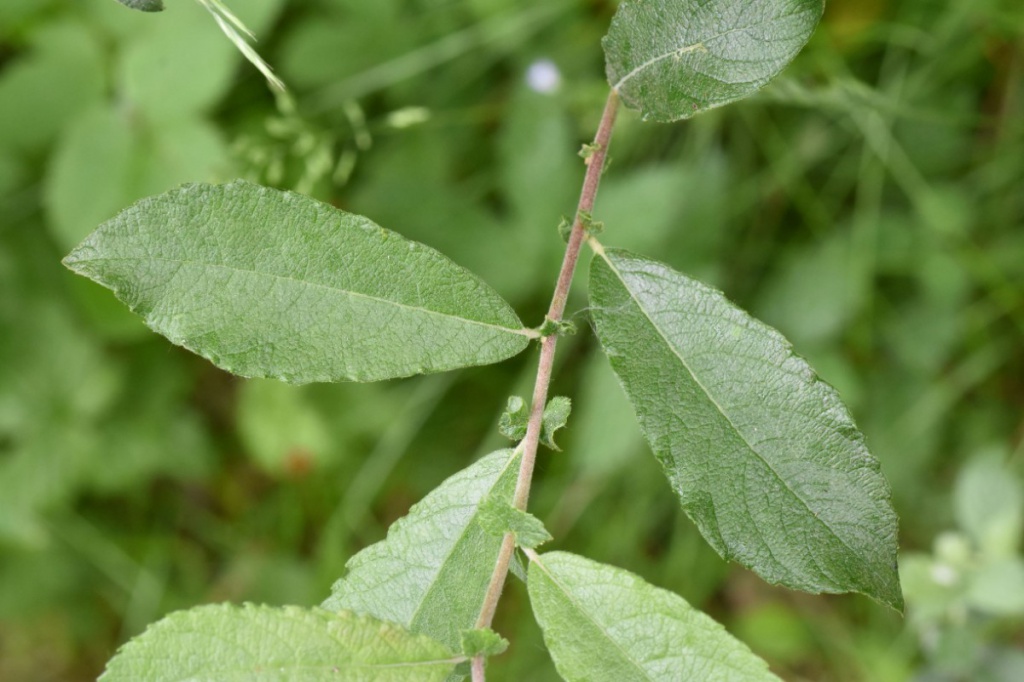
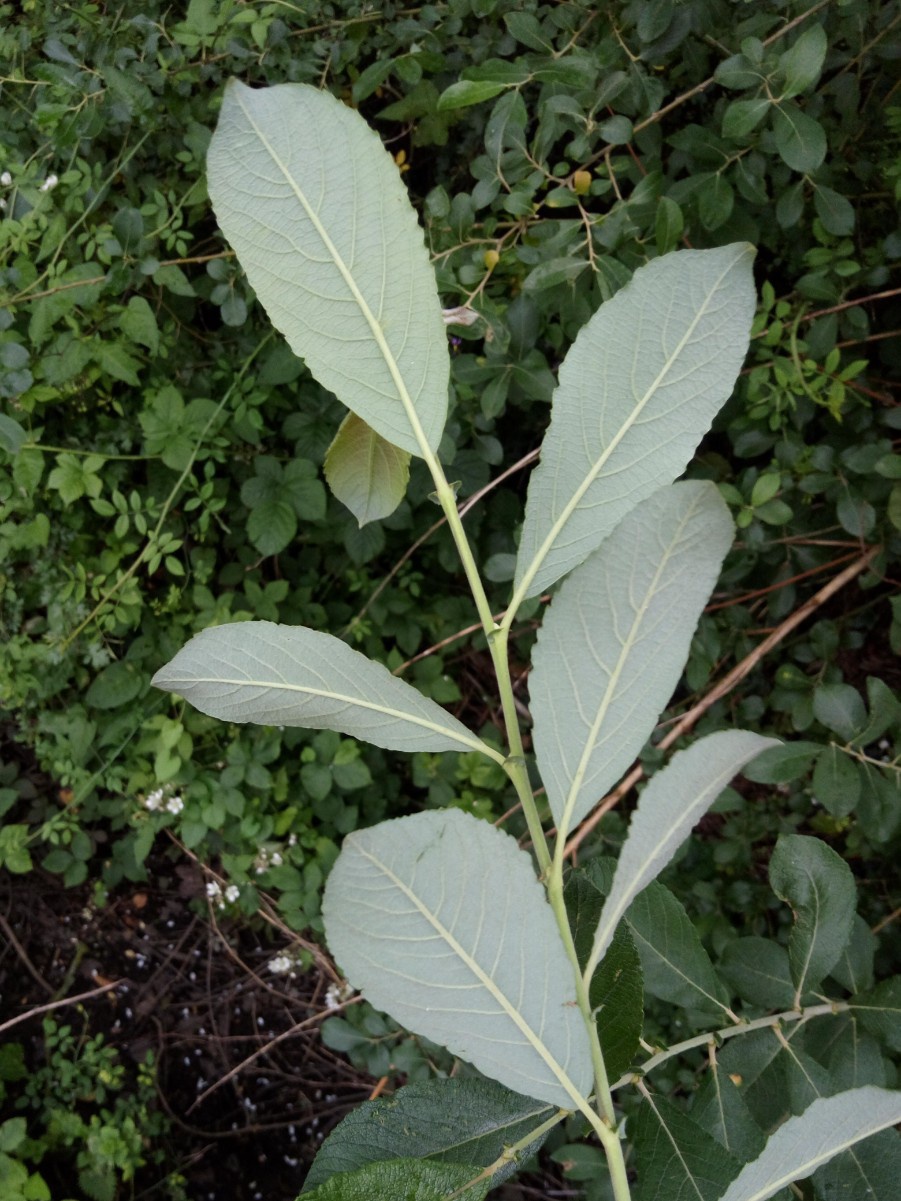
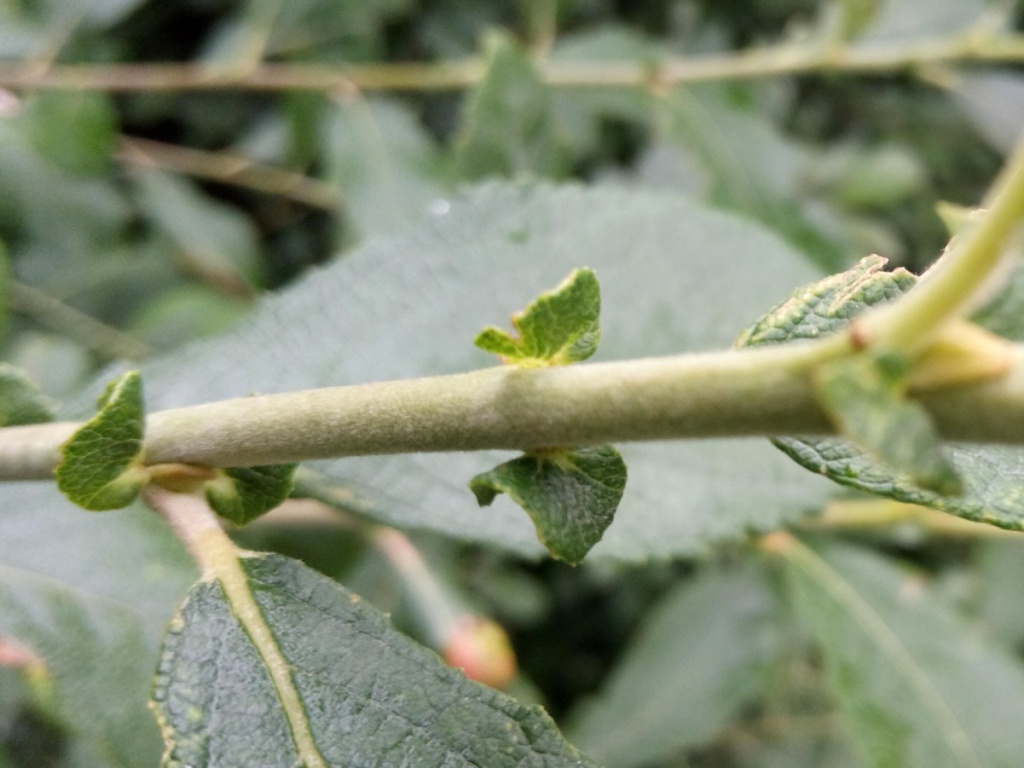
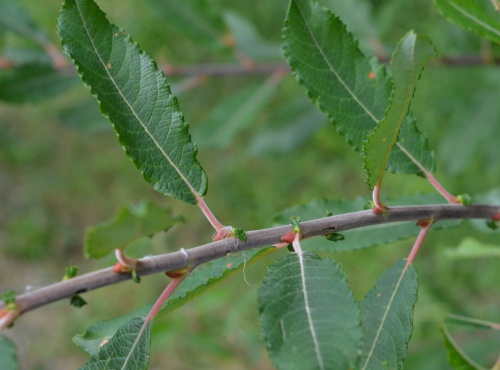
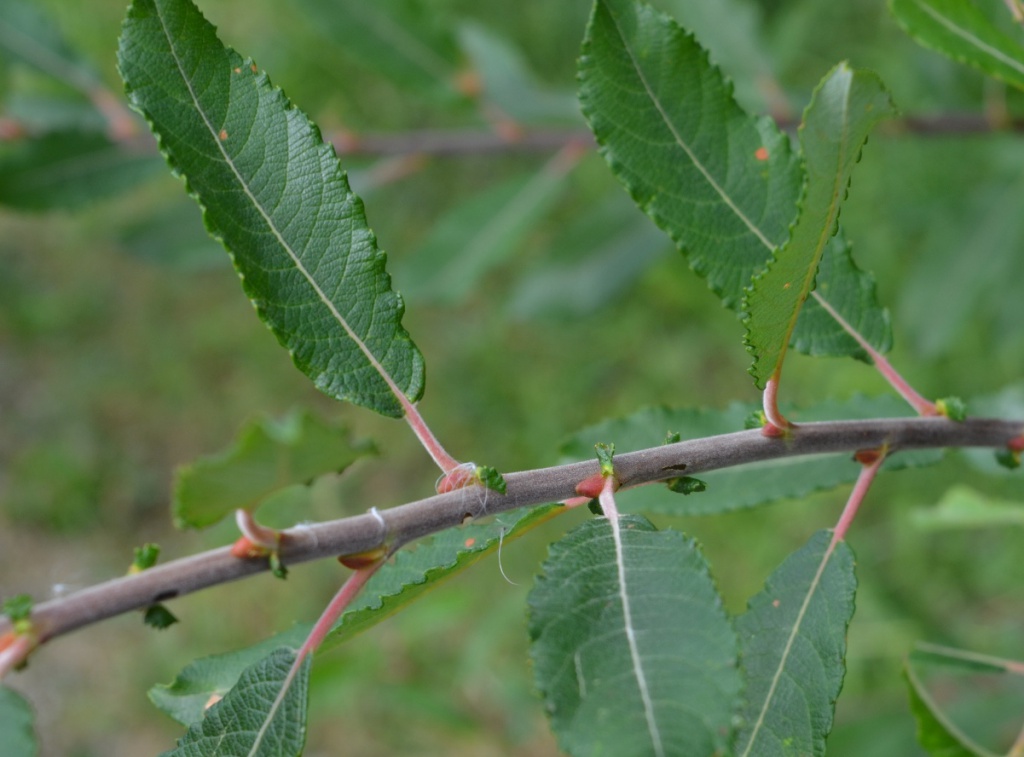
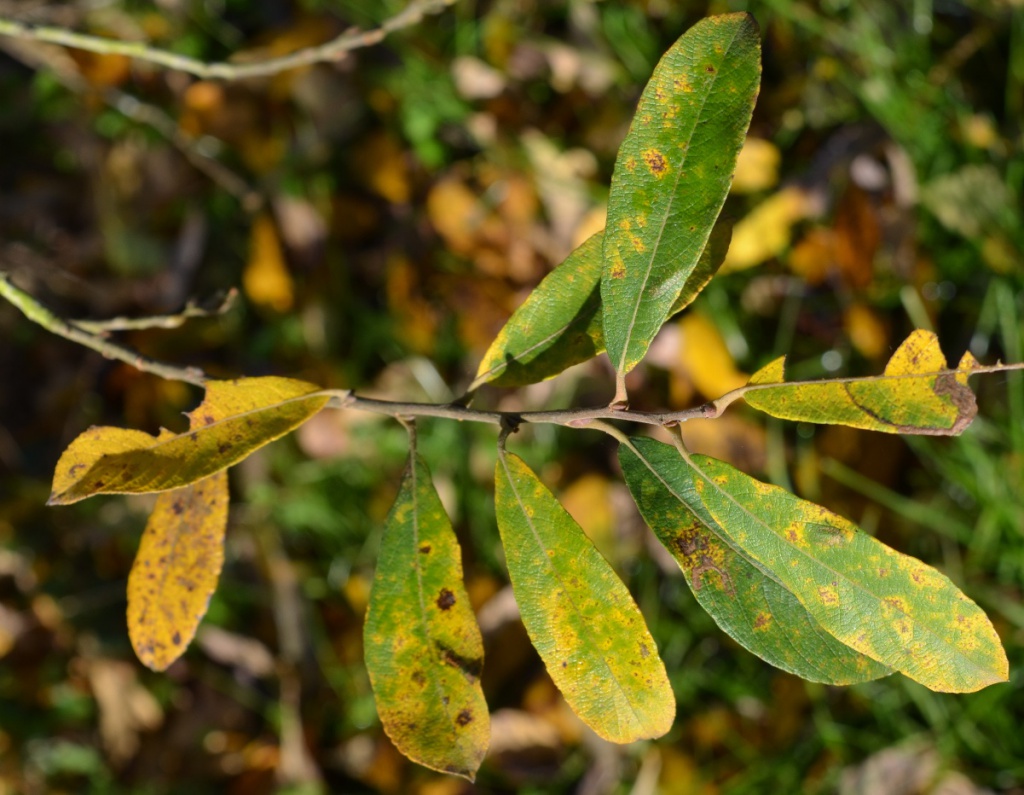
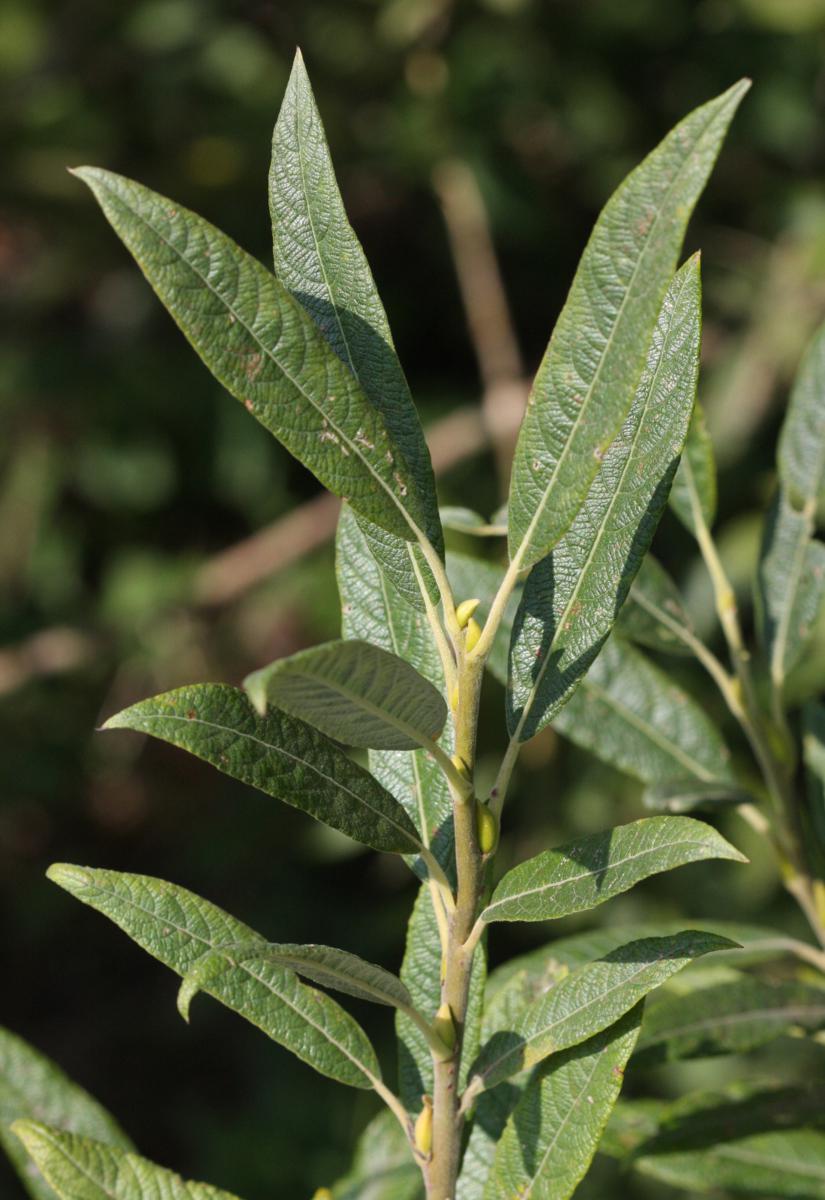
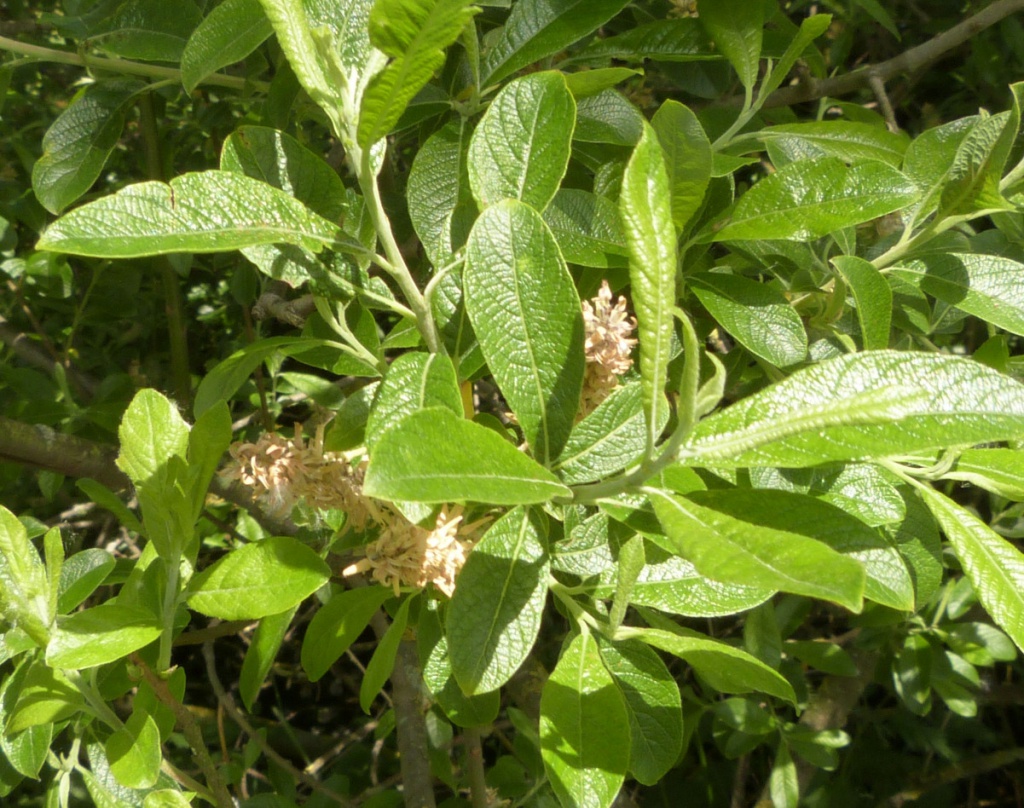
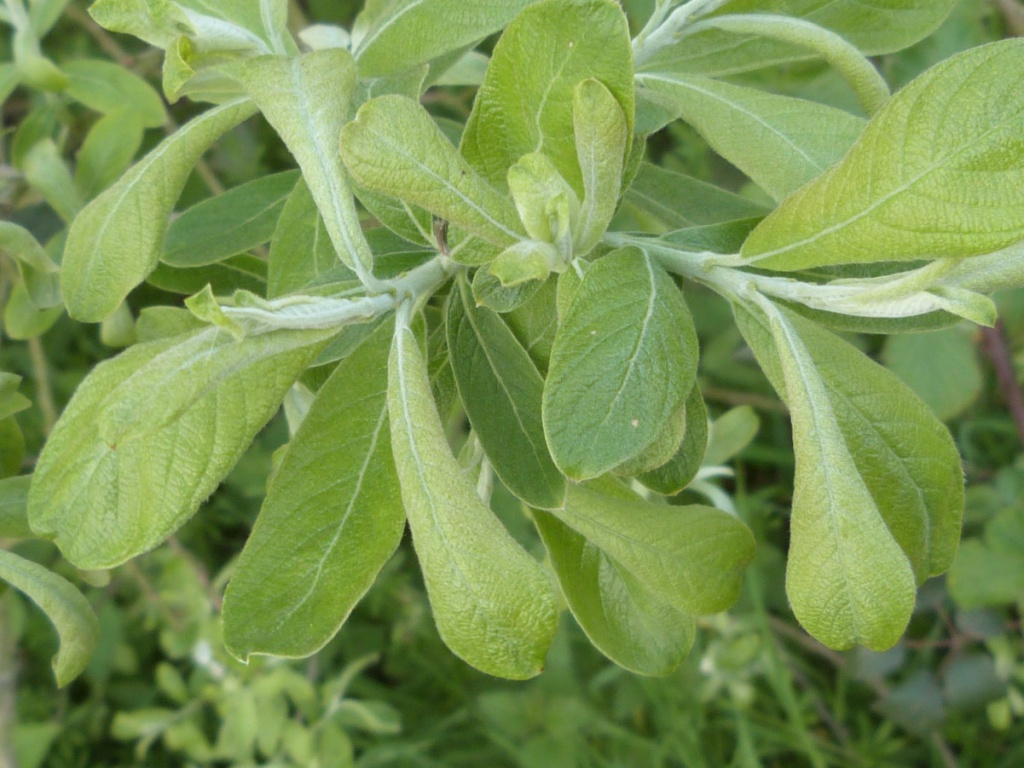
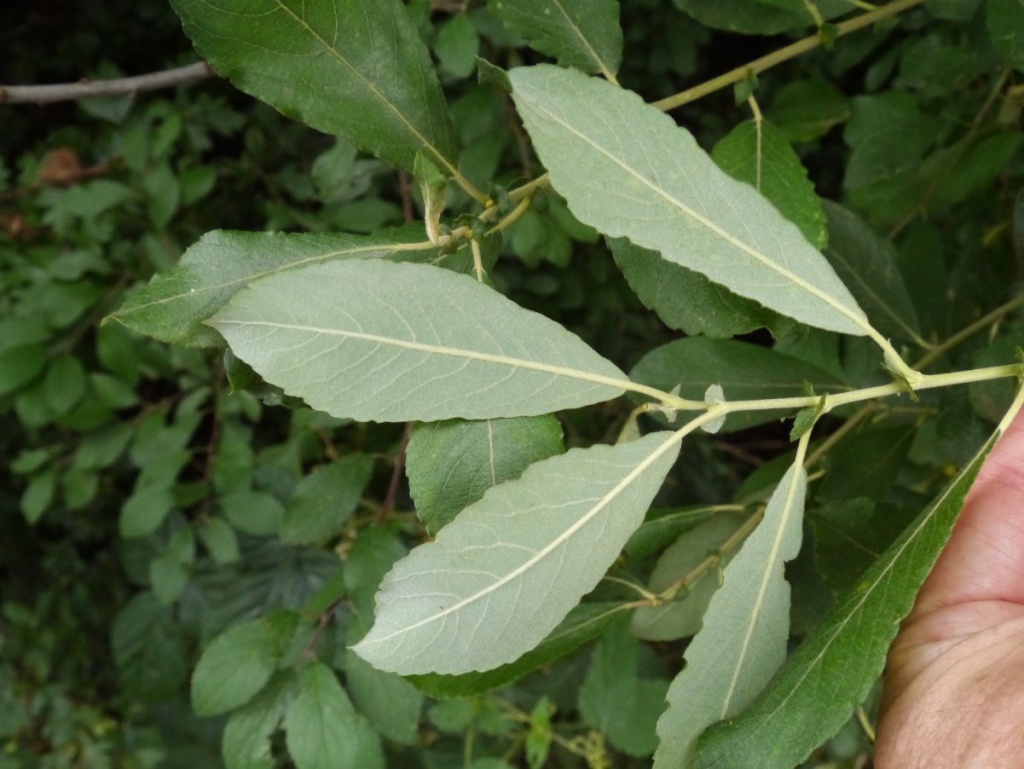
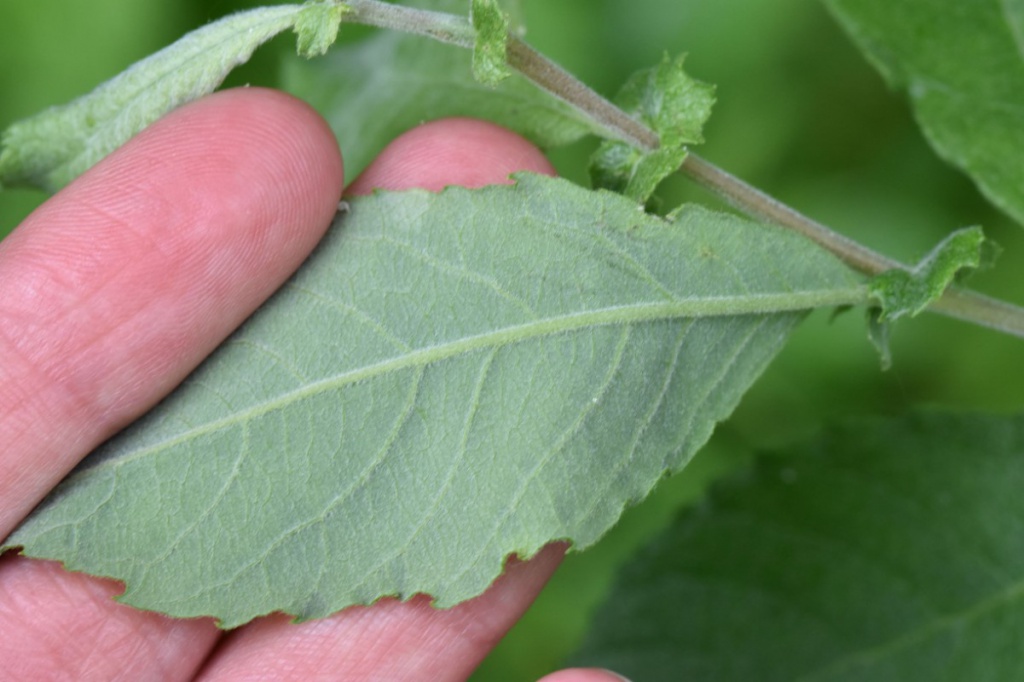
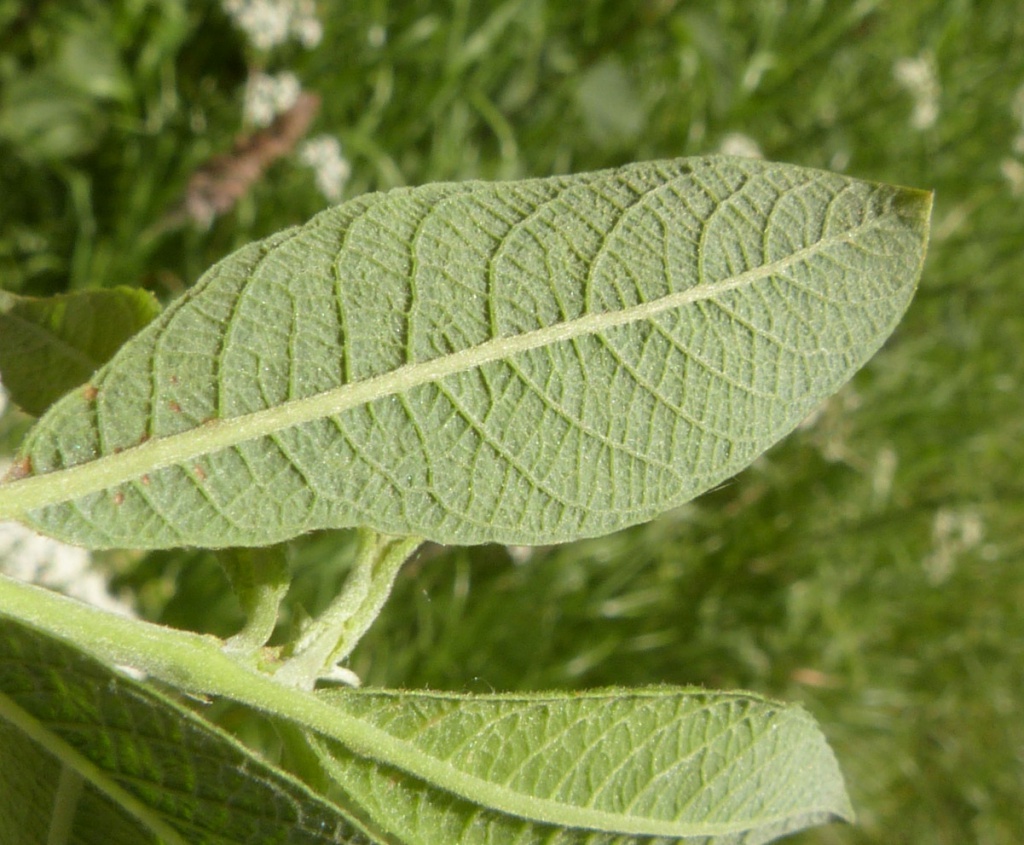
Usually a much branched shrub from 4 to 6 metres, twigs remaining pubescent for some time and keeping some of their hair covering until the end of their second year. Leaves oval, wavy, tapered at the base, very slightly serrate, green or greyish above, grey beneath. Stipules often persistent. Catkins 3.5 to 5 cm dense, almost unstalked, appearing before the leaves, almost unstalked, erect, cylindrical and yellow. Female catkins often smaller and narrower than the male with flask shaped ovaries.

Damp habitats, marsh areas, water margins.
Catkins April to May.
Deciduous.
Only common in central and eastern England.
Common in Leicestershire and Rutland. In the 1979 Flora survey of Leicestershire it was found in 423 of the 617 tetrads.
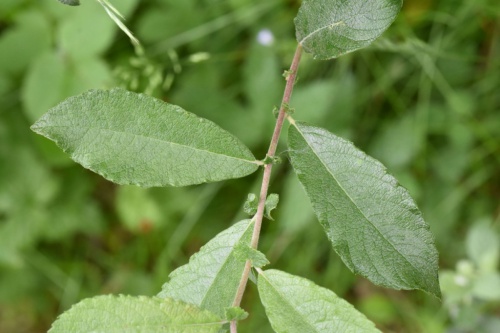 stepgray4
Cloud Wood
10 June 2021
Leaves three times as long as wide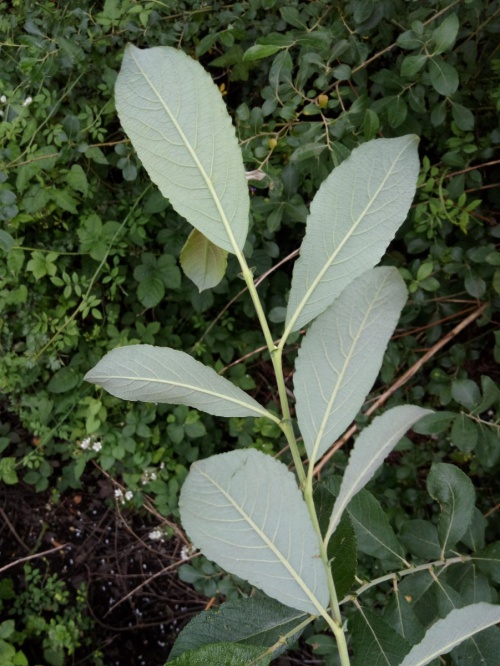 Peter Smith
Cropston
03 July 2020
Leaves tapered, grey beneath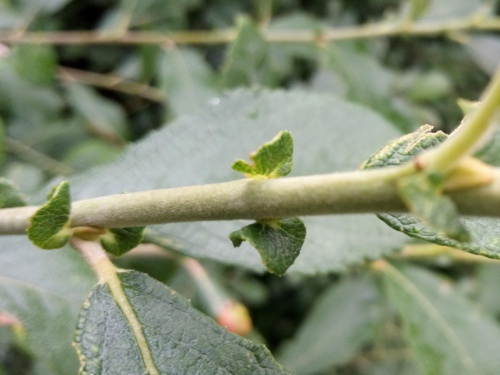 Peter Smith
Cropston
03 July 2020
Young stems downy, with stipules female flowers Marsh Old Fosse Sapcote SP 4969 9214 (taken 6.4.2008).JPG) Graham Calow
Graham Calow
Marsh near Old Fosse, Sapcote
06 April 2008
female flowers male flowers Marsh near Old Fosse Sapcote SP 4950 9207 (taken 14th March 2008),.JPG) Graham Calow
Graham Calow
Marsh near Old Fosse, Sapcote
14 March 2008
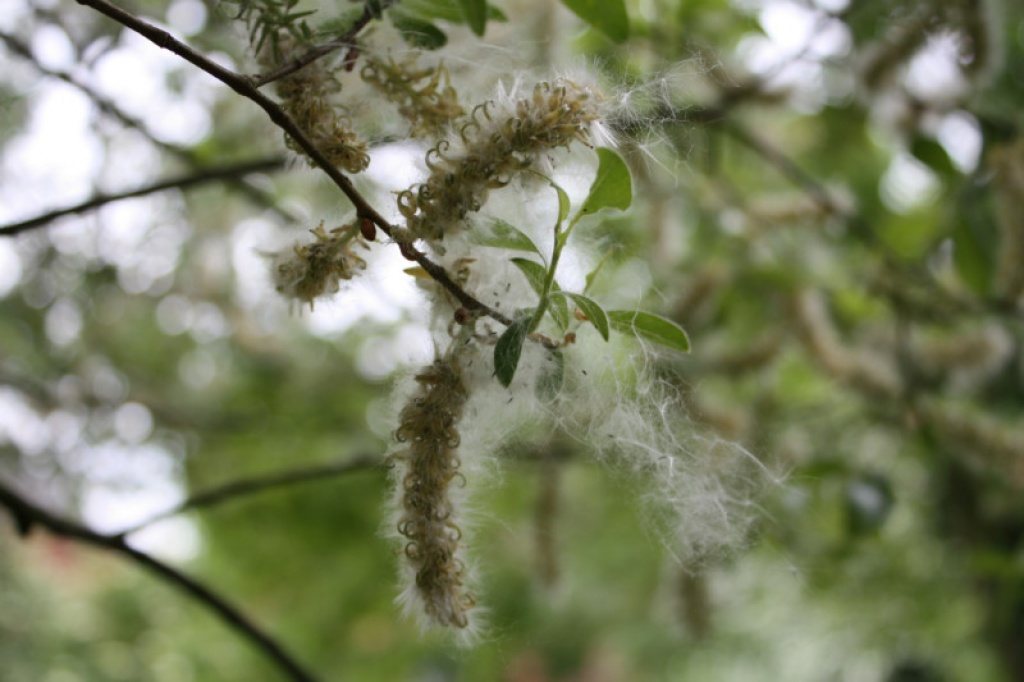
male flowers seeding Marsh along Old Fosse Sapcote SP 4969 9214 (taken 11.6.2008)..JPG) Graham Calow
Graham Calow
Marsh near Old Fosse, Sapcote
11 June 2008
seeding catkins
 female flowers Marsh Old Fosse Sapcote SP 4969 9214 (taken 6.4.2008).JPG)
 male flowers Marsh near Old Fosse Sapcote SP 4950 9207 (taken 14th March 2008),.JPG)
 seeding Marsh along Old Fosse Sapcote SP 4969 9214 (taken 11.6.2008)..JPG)
Leicestershire & Rutland Map
Enter a town or village to see local records
MAP KEY:
Yellow squares = NBN records (all known data)
Coloured circles = NatureSpot records: 2025+ | 2020-2024 | pre-2020
UK Map
Species profile
- Common names
- Grey Willow
- Species group:
- flowering plant
- Kingdom:
- Plantae
- Order:
- Malpighiales
- Family:
- Salicaceae
- Records on NatureSpot:
- 106
- First record:
- 01/07/1998 (John Mousley)
- Last record:
- 14/06/2025 (Nicholls, David)
Total records by month
% of records within its species group
10km squares with records
The latest images and records displayed below include those awaiting verification checks so we cannot guarantee that every identification is correct. Once accepted, the record displays a green tick.
In the Latest Records section, click on the header to sort A-Z, and again to sort Z-A. Use the header boxes to filter the list.
Latest images
Latest records
 Steve Mathers
Grantham Canal ( County Boundary to Muston Gorse Bridge)
28 August 2016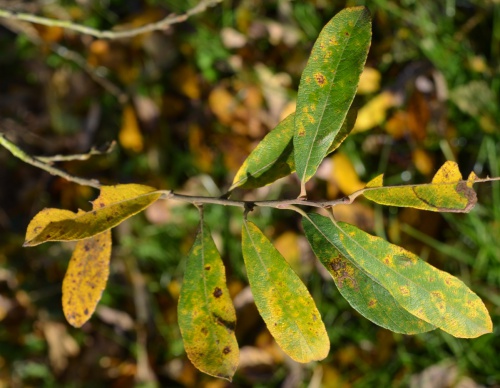 Steve Mathers
River Soar (south of Ratcliffe on Soar)
19 November 2016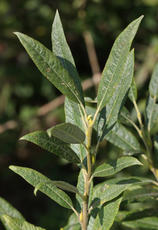 David Nicholls
Ullesthorpe Stewardship Farm
02 September 2011 Marsh along Old Fosse Sapcote SP 4950 9207 (taken 11.6.2008).JPG) Graham Calow
Graham Calow
Marsh near Old Fosse, Sapcote
11 June 2008
leaves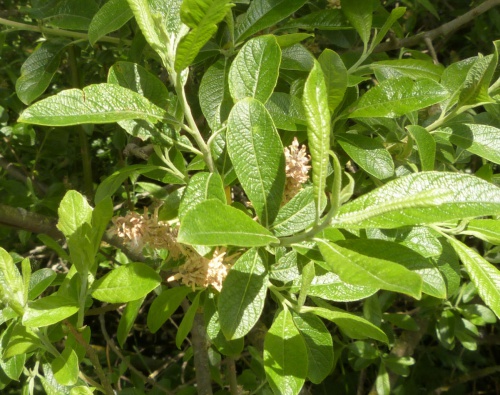 Graham Calow
Witherley
27 May 2015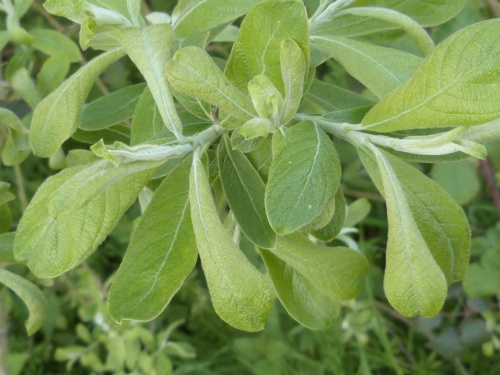 Graham Calow
Wykin
12 May 2015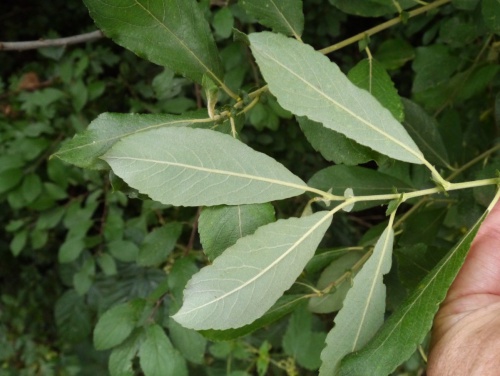 Peter Smith
Packington, Redburrow Lane
04 August 2021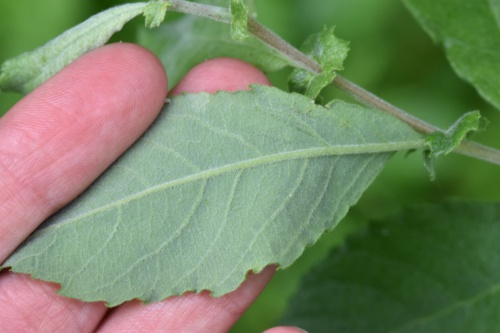 stepgray4
Cloud Wood
10 June 2021
Grey hairs on the underside of leaves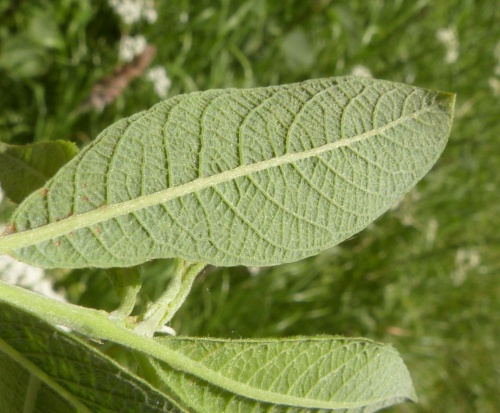 Graham Calow
Witherley
27 May 2015 Marsh along Old Fosse Sapcote SP 4950 9207 (taken 15.10.2007)..,,.JPG) Graham Calow
Graham Calow
Marsh near Old Fosse, Sapcote
15 October 2007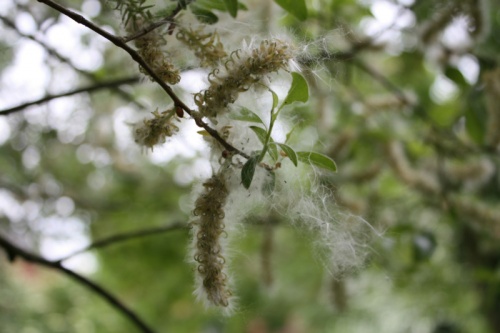 Barbara Cooper
Long Clawson
26 May 2010
Seeds emerging from catkins
 Marsh along Old Fosse Sapcote SP 4950 9207 (taken 11.6.2008).JPG)
 Marsh along Old Fosse Sapcote SP 4950 9207 (taken 15.10.2007)..,,.JPG)
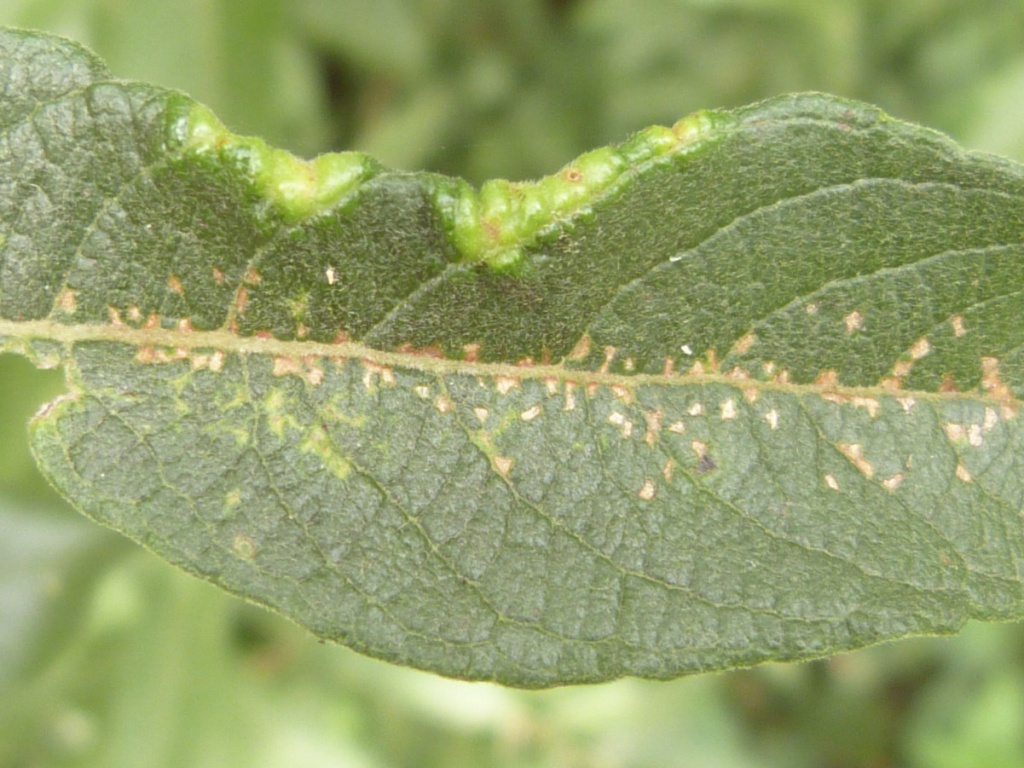
Dasineura auritae
The larva of the gall midge Dasineura auritae causes galls on Sallows (Salix.) The leaf edges roll downwards, causing the margin to become concave. The living larva is yellow with only one larva in each gall. Two generations per year: the summer generation pupates within the gall, the winter generation in the ground.
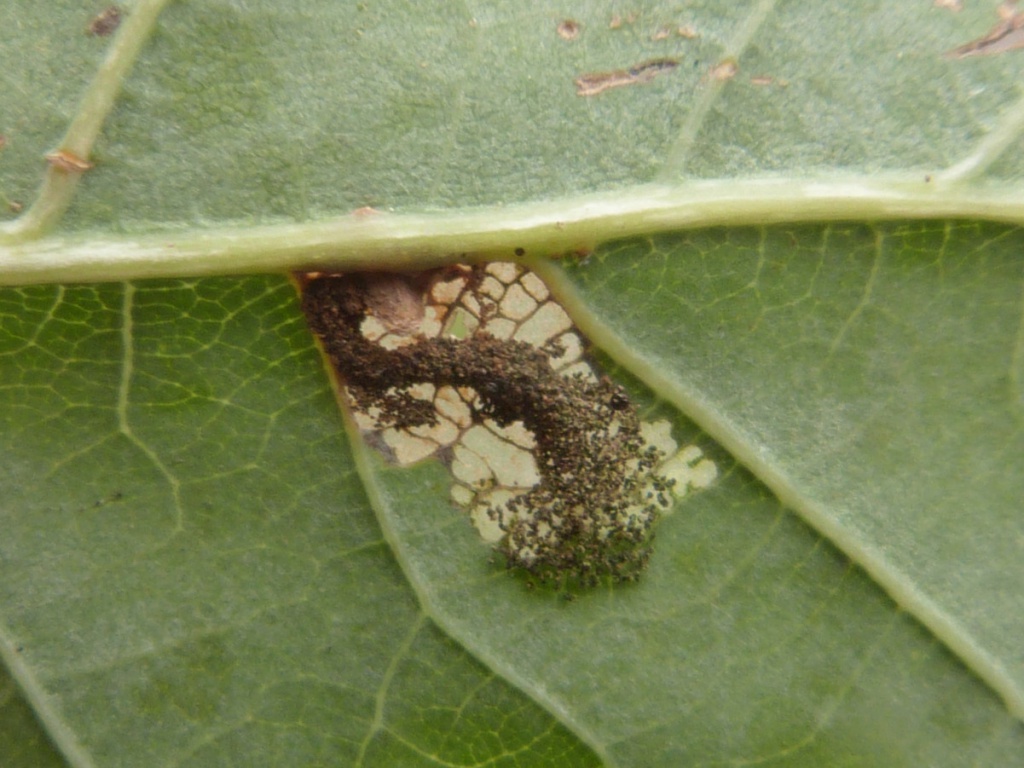
Gypsonoma dealbana
The larva of the moth Gypsonoma dealbana mines the leaves of various species of trees and shrubs, commonly willows, or oak, but may be other species. The larva then feeds from a silken tube crusted with frass, on the underside of the leaf beside the midrib, retreating into the midrib when disturbed. The larva is pale grey or yellowish-cream in colour.

Coleophora lusciniaepennella
The cased larva of the moth Coleophora lusciniaepennella feeds on various willow species. The larva forms a composite case of three leaf fragments sealed together into an irregularly shaped tube, adding each fragment at the oral end so that the anal end is older, and therefore darker in colour. The case often has a woolly appearance depending on the sallow species used to construct it. It overwinters attached to a twig, resuming feeding in Spring. The larval feeding makes white blotches on the leaves, each with a central hole where the case was attached.
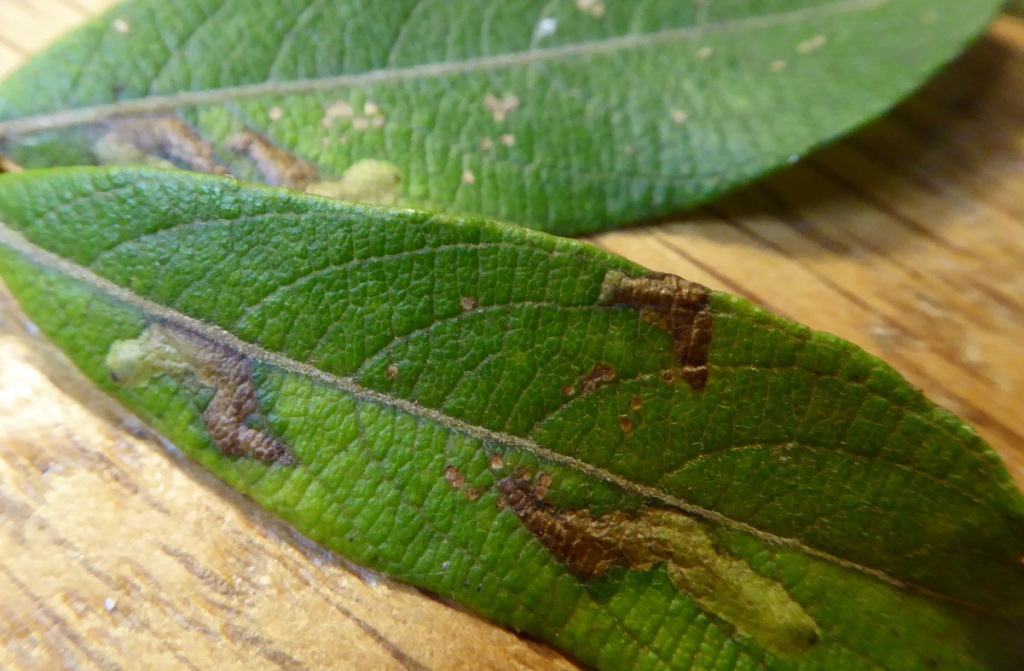
Rhamphus pulicarius
Mines are formed by the larva of the weevil Rhamphus pulicarius on the leaves of willow, poplar or ocasionally birch. The mine is a short, broad gallery becoming a blotch; often pear-shaped.. The larva is small, squat, and yellow or orange in colour, with a dark head.
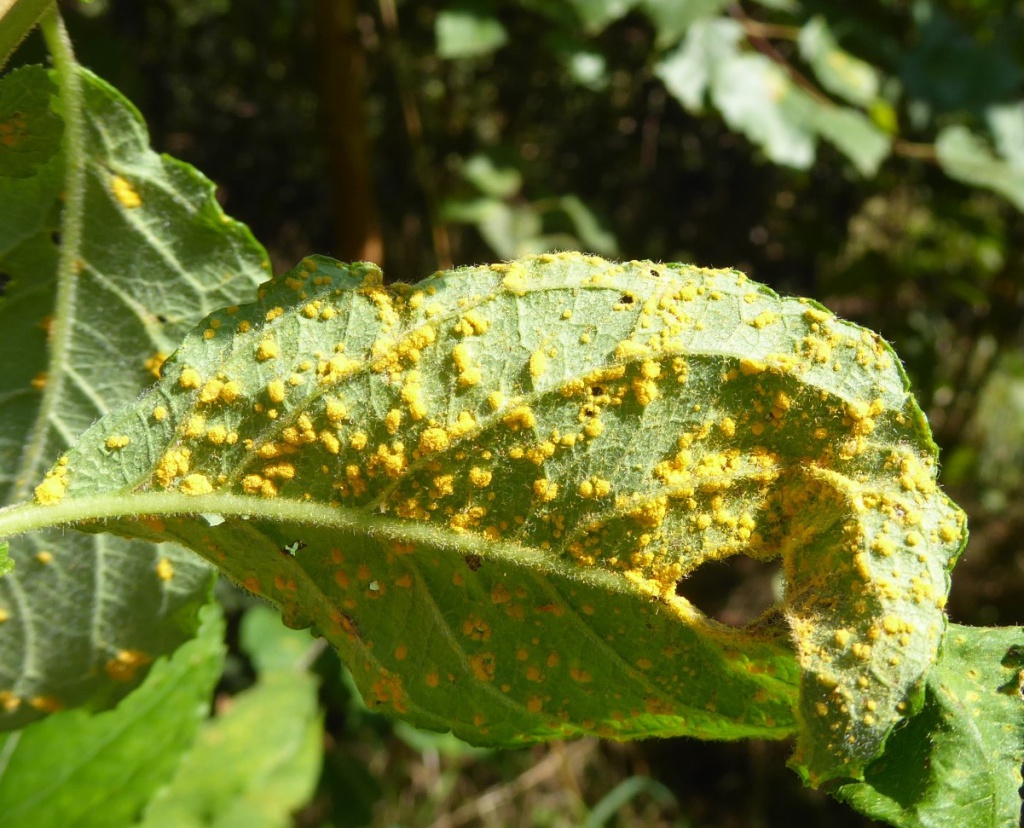
Melampsora caprearum
The rust fungus Melampsora caprearum affects various willows such as Goat Willow, Grey Willow and Eared Willow. The leaf blade or veins become distorted with irregular thickened spots bearing orange-yellow uredinia and later on, telia.
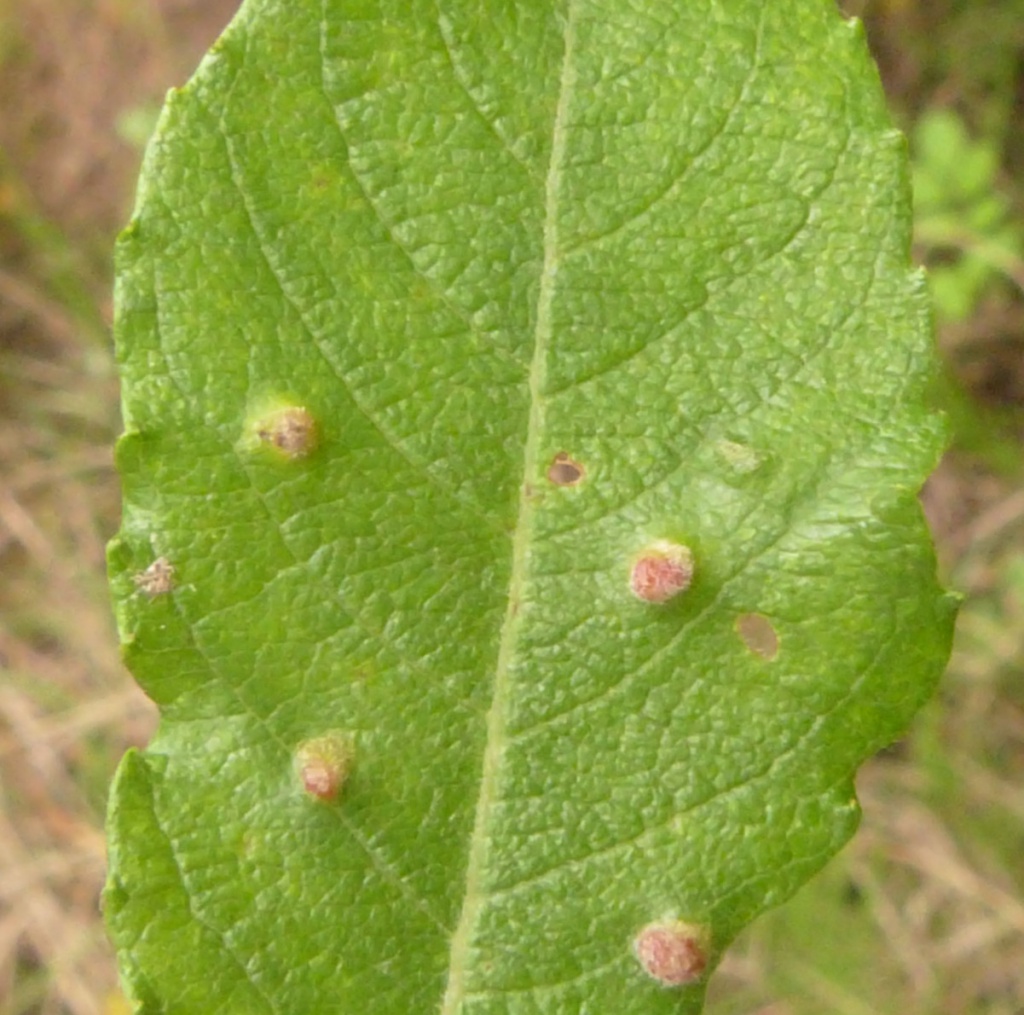
Aculus laevis
Aculus laevis is a gall mite that causes slightly hairy, more or less spherical galls to form on the leaves of sallows. The galls are 1 to 2 mm high and firmly attached to the leaves; the hairs protrude through the opening on underside. The galls may be on the leaf margin.
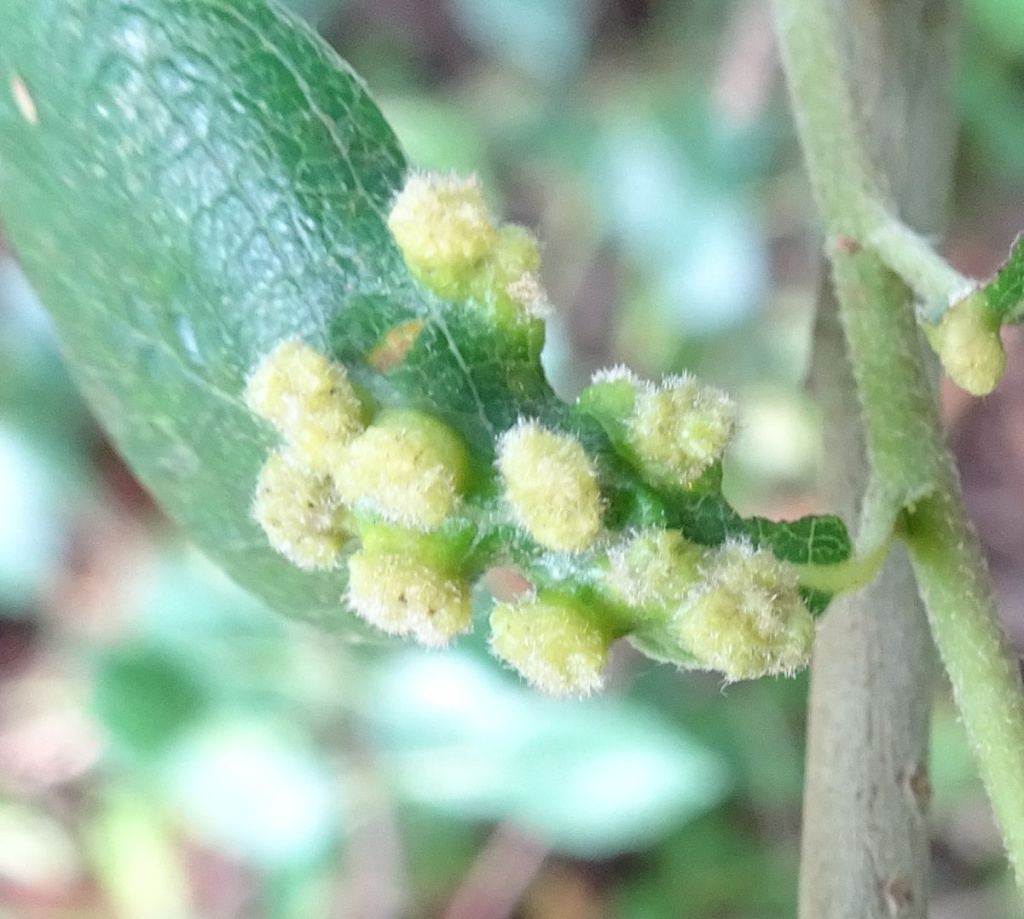
Aceria iteina
The gall mite Aceria iteina causes galls to form on the leaves of Grey Willow, Goat Willow and Eared Willow. The galls may be hairy in appearance, 2 to 4 mm tall and narrower at the base looking rather toadstool-like.
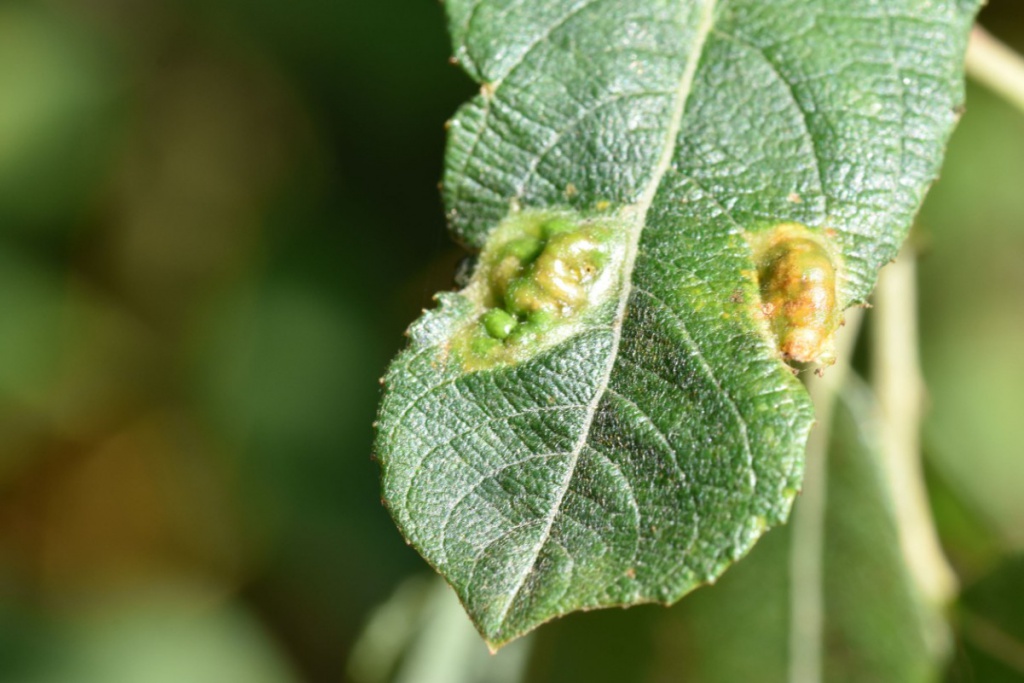
Euura bergmanni
The larva of the sawfly Euura bridgmanii causes a gall to form on broad-leaved species in the willow family, including Goat Willow, Grey Willow and Eared Willow. The galls protrude from both sides of the leaf, and are often reddish or purplish; they usually do not touch the midrib.
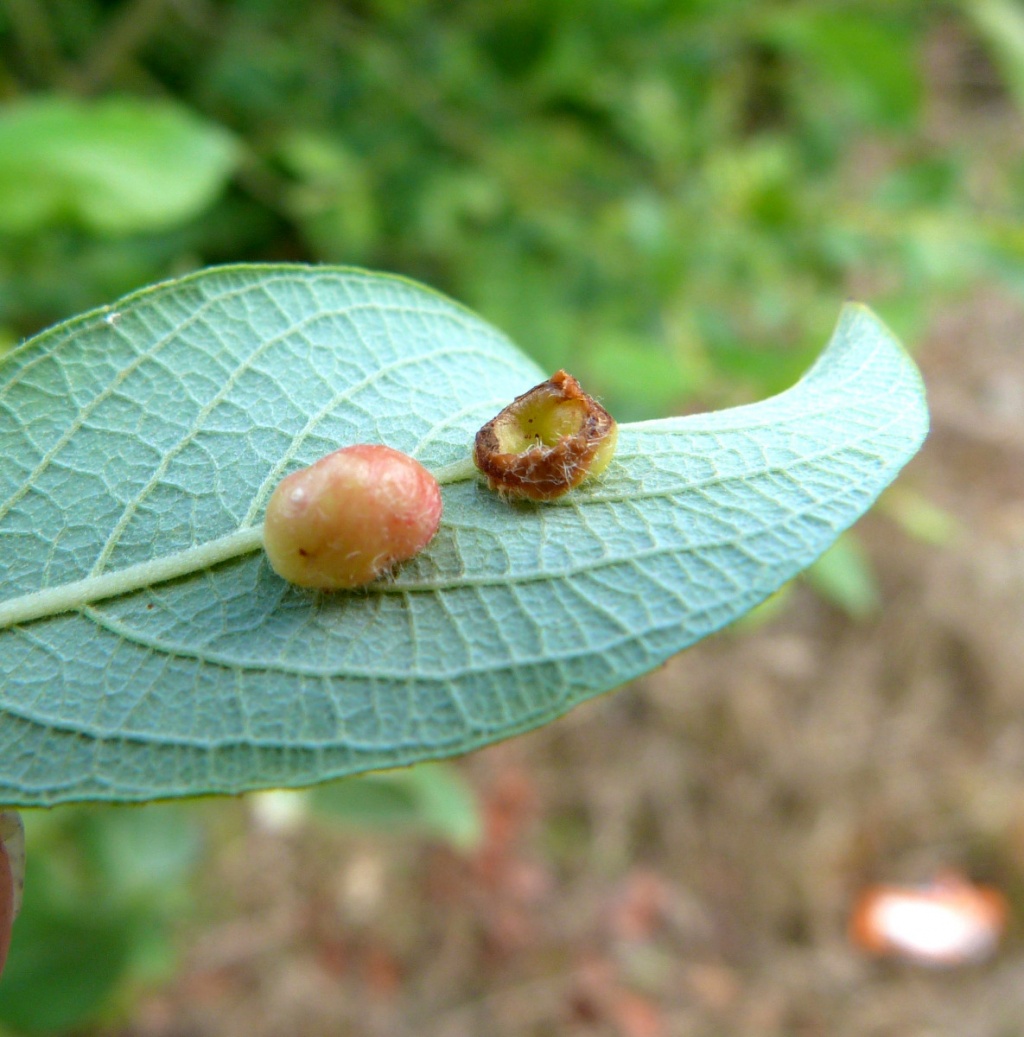
Willow Gall Sawfly
The larva of the Willow Gall Sawfly (Euura pedunculi) causes a gall on Goat Willow, Grey Willow and Eared Willow. The gall is generally pea-shaped, starting green but becoming red as it matures. It is hairy (sometimes very hairy, or sparsely so) and only found on the underside of the leaf; there may be a slight mark on the upperside.

Rabdophaga salicis
The larva of the gall midge Rabdophaga salicis forms galls on certain Sallow and Willow species (Salix sp.) including Creeping Willow, Eared Willow, Grey Willow and Goat Willow. The gall is a smooth, globular or spindle-shaped swelling, usually on a twig or stem, sometimes several together and sometimes coalescing. The galls contain several larvae or pupae in separate chambers. The galls are usually at least 5mm wide and the larvae feed on the pith inside the gall. The gall occasionally occurs on the petiole, midrib, or side veins of a leaf.
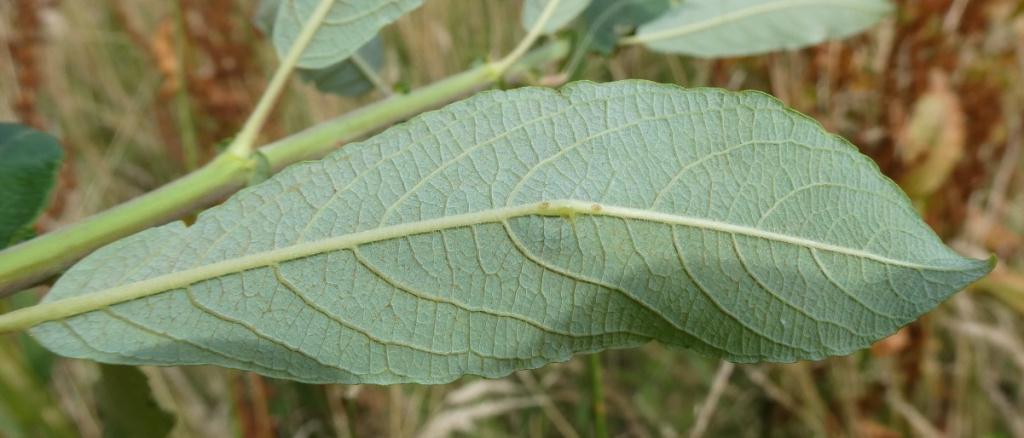
Rabdophaga nervorum
The larva of the gall midge Rabdophaga nervorum causes galls in the midrib of the leaves of some species of willow. A swelling is present in the midrib, with a pale larva or pupa inside. Adjacent leaf tissue darker and appears thickened; midrib may also be bent.
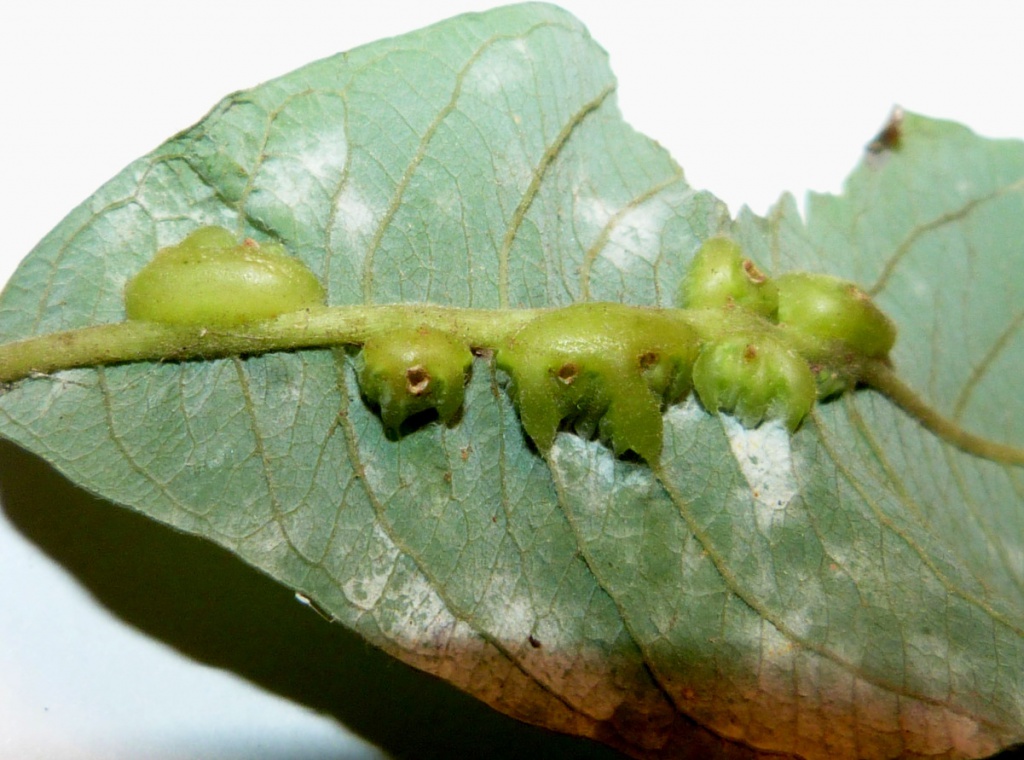
Iteomyia major
The larva of the gall midge Iteomyia major causes galls to form on the leaves of some willows such as Grey Willow and Goat Willow. These take the form of a coalesced group of 2 to 10 hard, round pustules incorporating the midrib and side veins, containing larvae which are white when young but later orange or red.
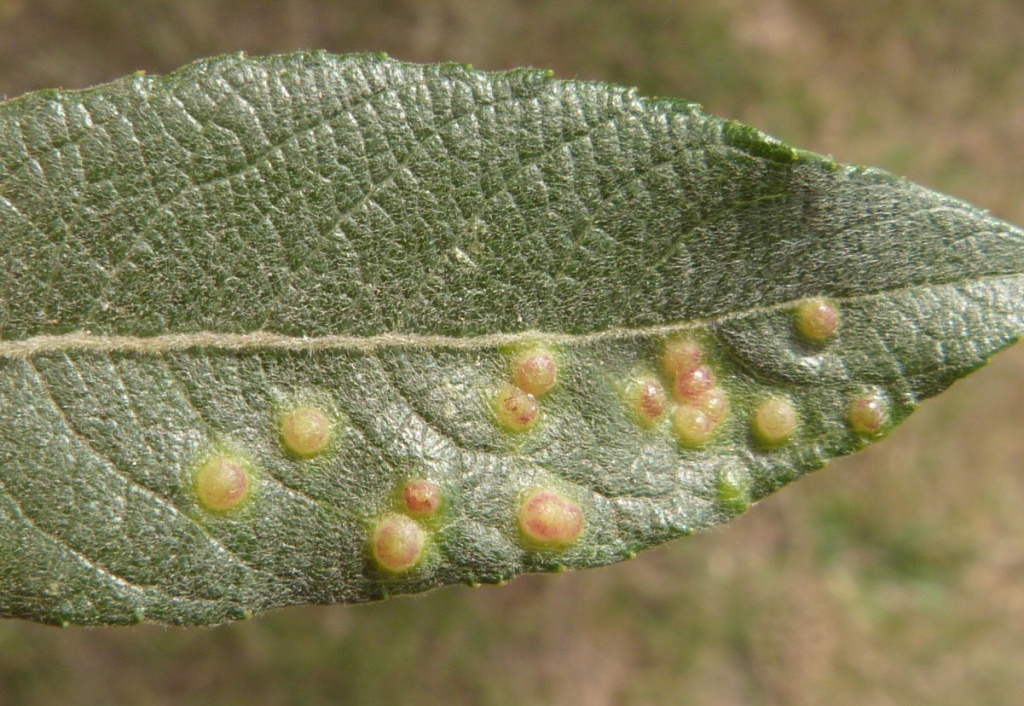
Iteomyia capreae
The larva of the gall midge Iteomyia capreae causes galls to form on the leaves of some willows such as Grey Willow and Goat Willow. The galls are small, and usually on the leaf surface forming a hard pouch, domed above and conical below, with a circular red-rimmed opening below; greenish, becoming yellow, brown, purple or red without hairs inside. Occasionally the galls are in side vein which become swollen and hard. Contains a larva which is white when young; later orange or red.
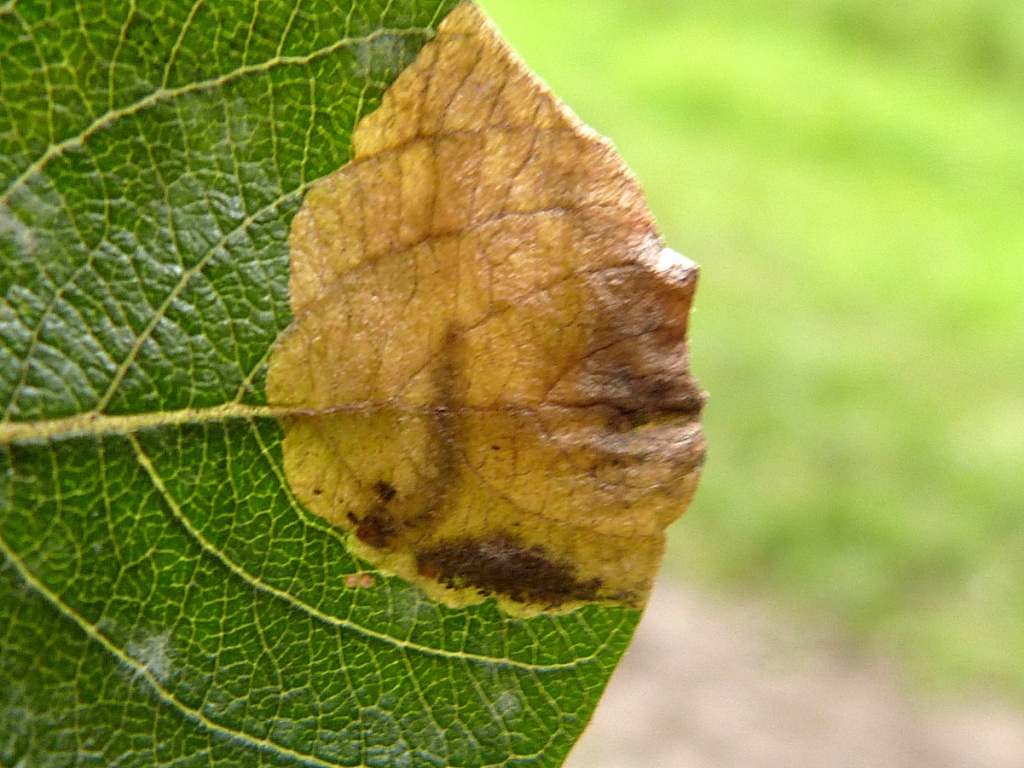
Heterarthrus microcephalus
The larva of the sawfly Heterarthrus microcephalus mines the leaves of willow with oviposition very near to the leaf tip. It eventually forms a large blotch mine, with little frass. The larva pupates in the mine in a discoid cocoon.
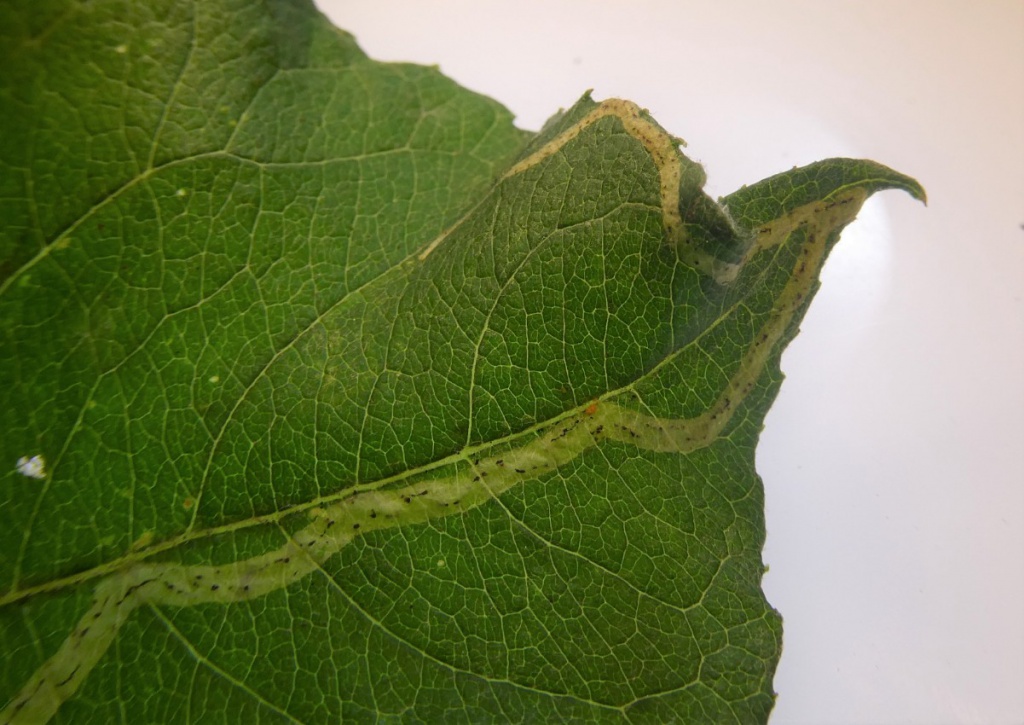
Aulagromyza fulvicornis
The larva of the Agromyzid fly Aulagromyza fulvicornis mines the leaves of Willows (Salix sp.). The mine is a corridor which hardly widens from beginning to end. The frass is in thread fragments in two broken lines.
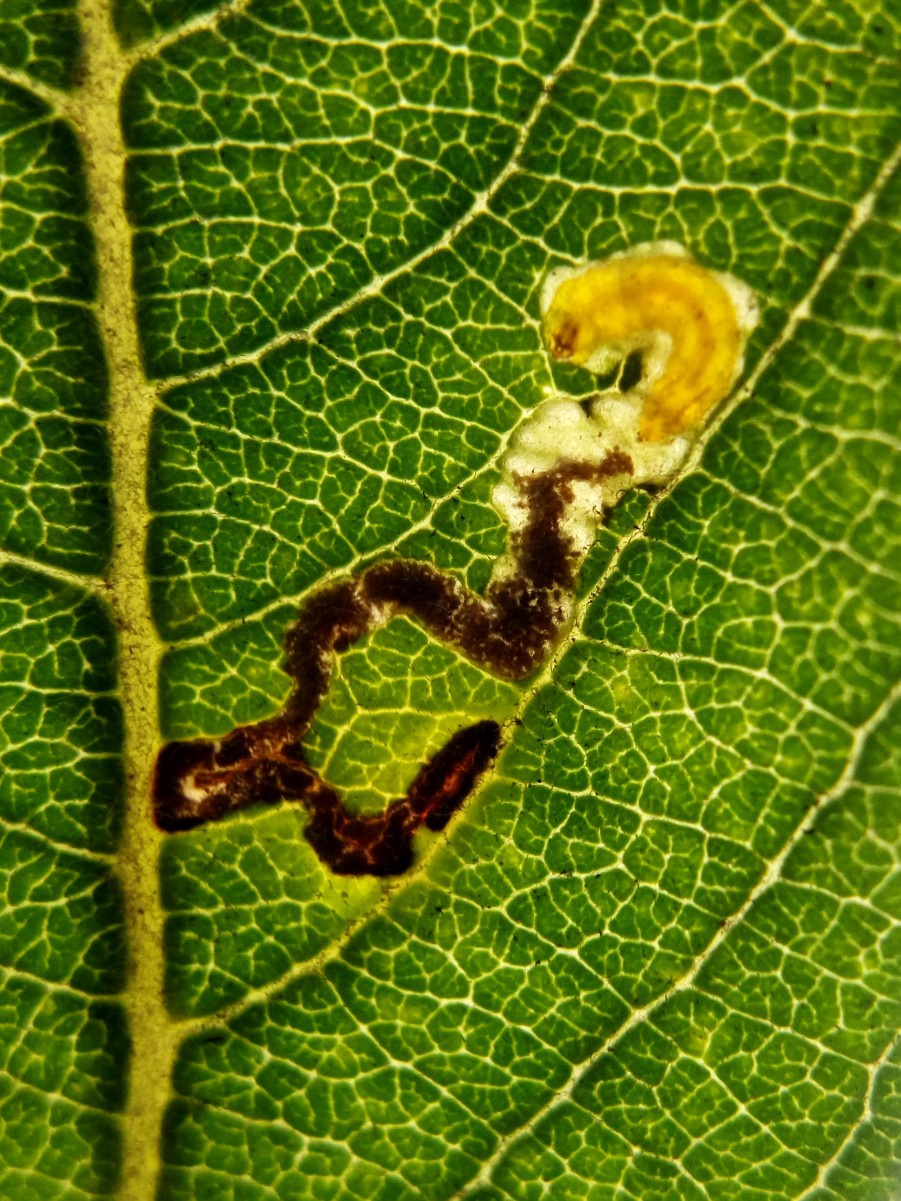
Stigmella salicis
The larva of the moth Stigmella salicis mines the leaves of rough leaved willows such as Grey Willow and Goat Willow. The mine is usually short and broad with a thick dark frass-line. It is very variable - ranging from a contorted gallery to a short angular gallery that looks more like a blotch; egg position also varies between upper and lower surfaces. If possible note egg position. The egg is a small shiny speck which can be hard to find on the leaf under-surface; it is often in a leaf axil or by a vein but may be hidden close up against the midrib and buried under the wooly leaf surface.
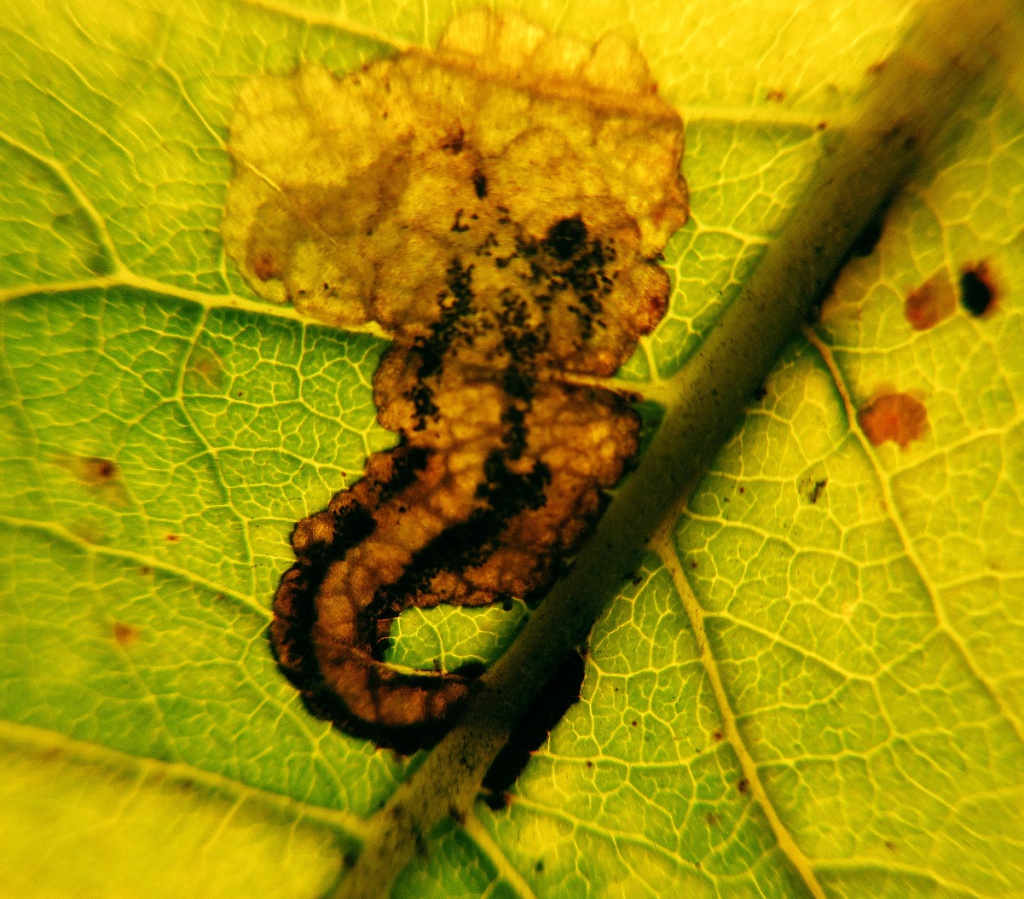
Ectoedemia intimella
The larva of the moth Ectoedemia intimella mines the leaves of various species of Willow especially Goat Willow and Grey Willow initially galling the leaf petiole before moving to the the midrib of the leaf. Subsequently it mines into the leaf-blade, forming a distinctive blotch which often contains two lines of frass.
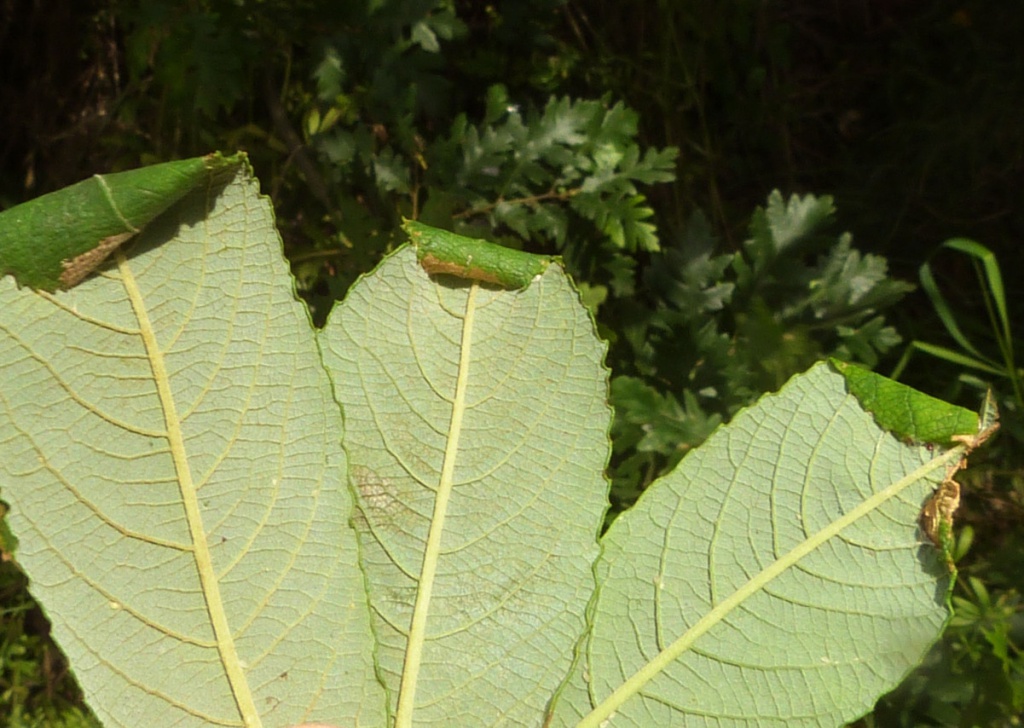
Caloptilia stigmatella
The larva of the moth Caloptilia stigmatella mines the leaves of willows and poplars, intially in a long narrow corridor usually on the undersurface of the leaf, then in a silvery blotch that developes into a tentiform mine with a brown epidermis. Finally the larva leaves the mine to live in a folded leaf margin or leaf-tip.
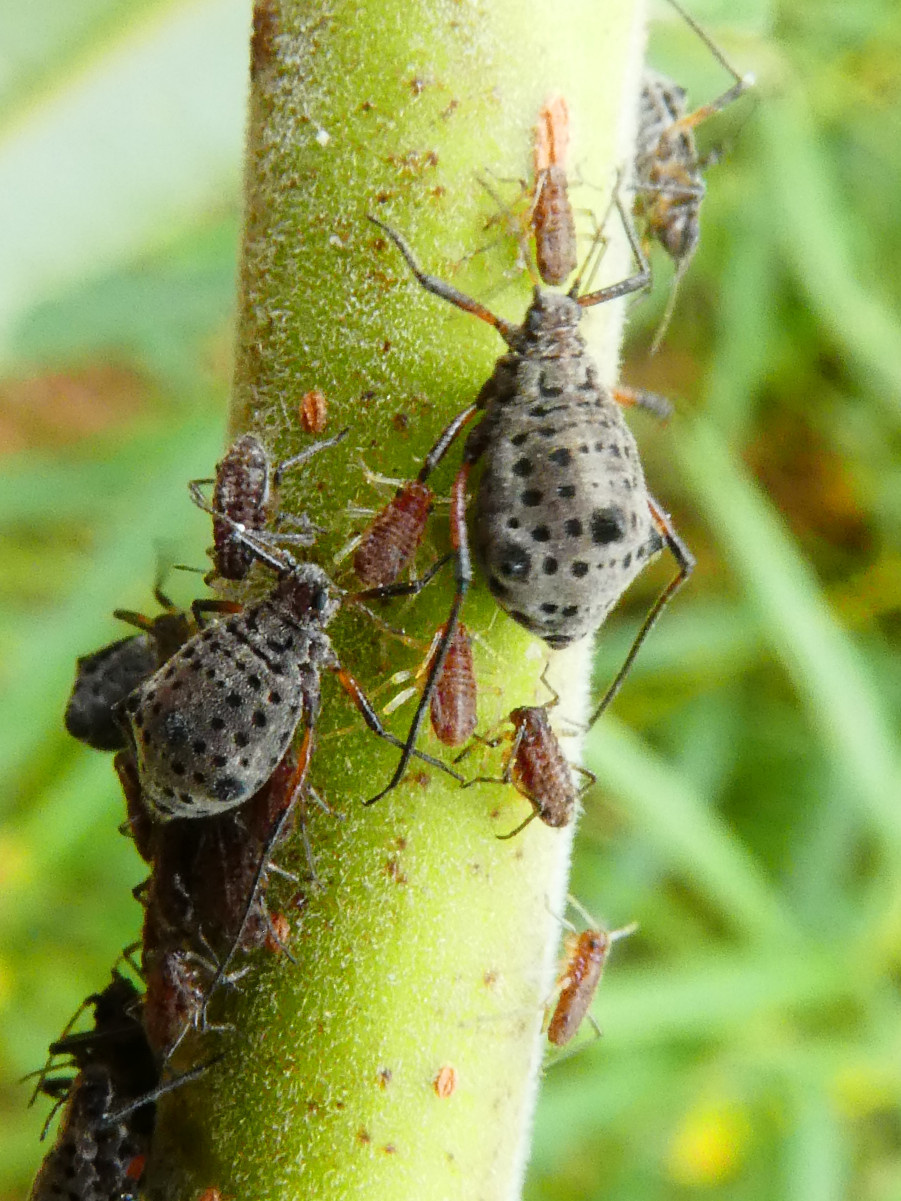
Giant Willow Aphid
The Giant Willow Aphid (Tuberolachnus salignus) is found primarily in large colonies on the trunks and branches of willow and sallow trees. Giant Willow Aphids are dark brown with a peppering of black spots but can appear grey from a white dust which forms on them. It is an unusually large aphid, measuring up to 6mm long. Adults of the species have a thorn-like tubercle which protrudes from its back. As with other species of aphid, some giant willow aphids are winged; an adaptation believed to emerge in reaction to environmental pressures. The aphids splay their back legs and kick in response to potential threats.
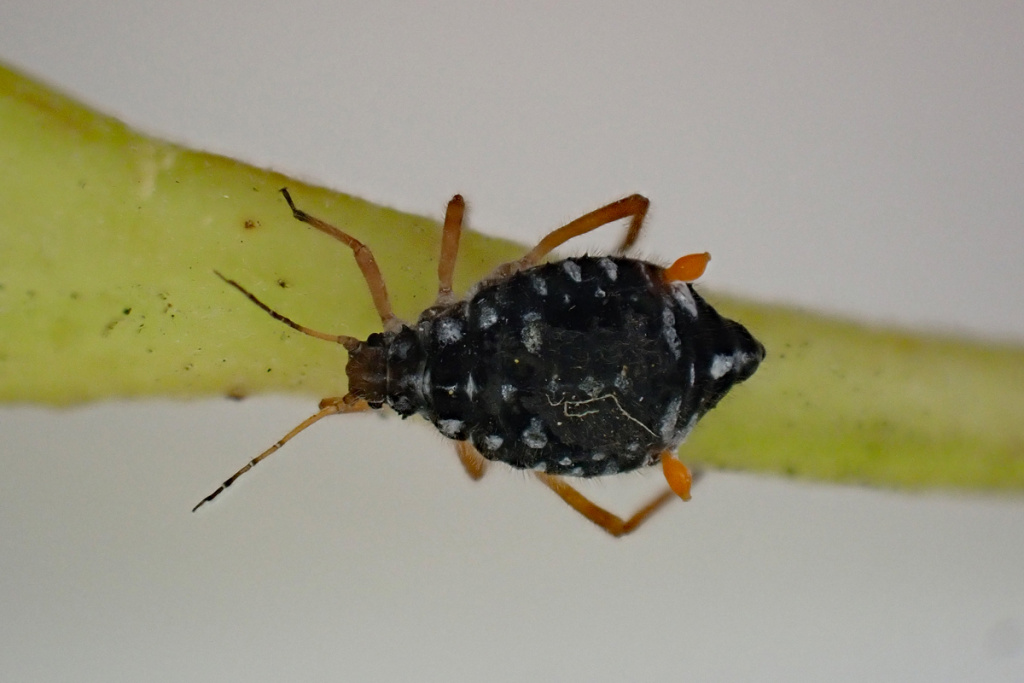
Black Willow Bark Aphid
Black Willow Bark Aphid (Pterocomma salicis) uses a variety of Salix species including Osier, White Willow, Goat Willow, Grey Willow, and Hybrid Crack-willow. These are large greenish black to black aphids 3.2 - 4.5 mm in length with pale grey spots of waxy powder. The siphunculi are bright orange. The legs and antennae are pinkish-brown.
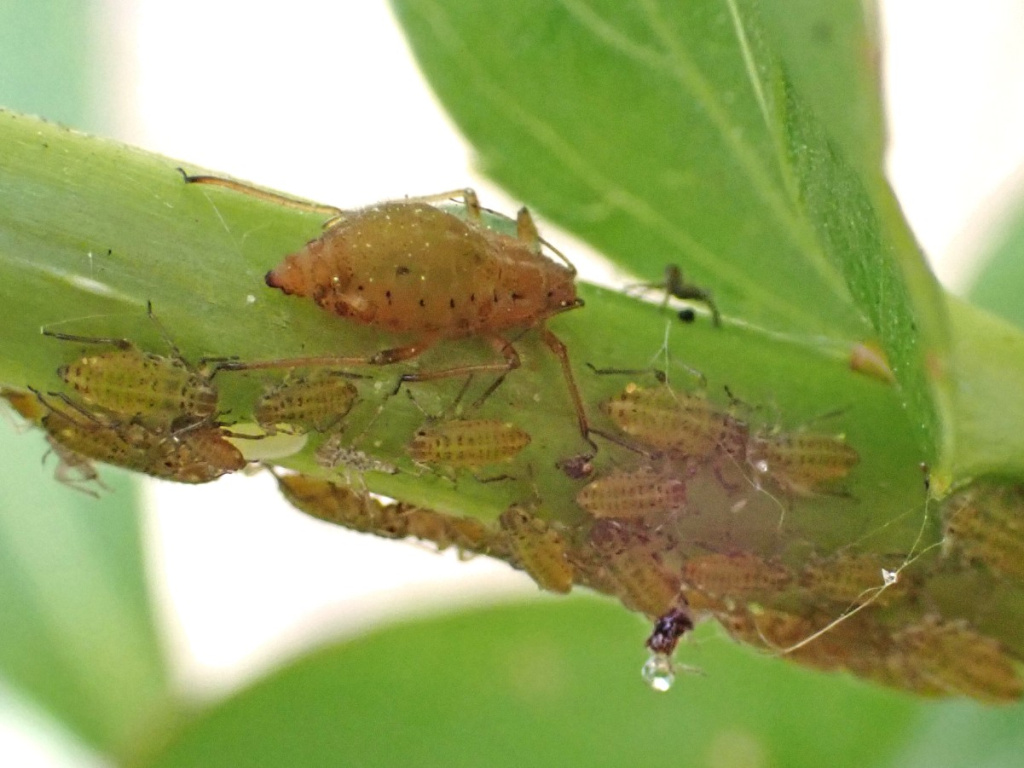
Rufous Willow Bark Aphid
The Rufous Willow Bark Aphid (Pterocomma rufipes) primarily lives on the twigs and young branches of a variety of Salix species. It can be found on both broad-leaved willows such as Grey Willow and Goat Willow and also on narrow-leaved willows such as Hybrid Crack-willow and White Willow.
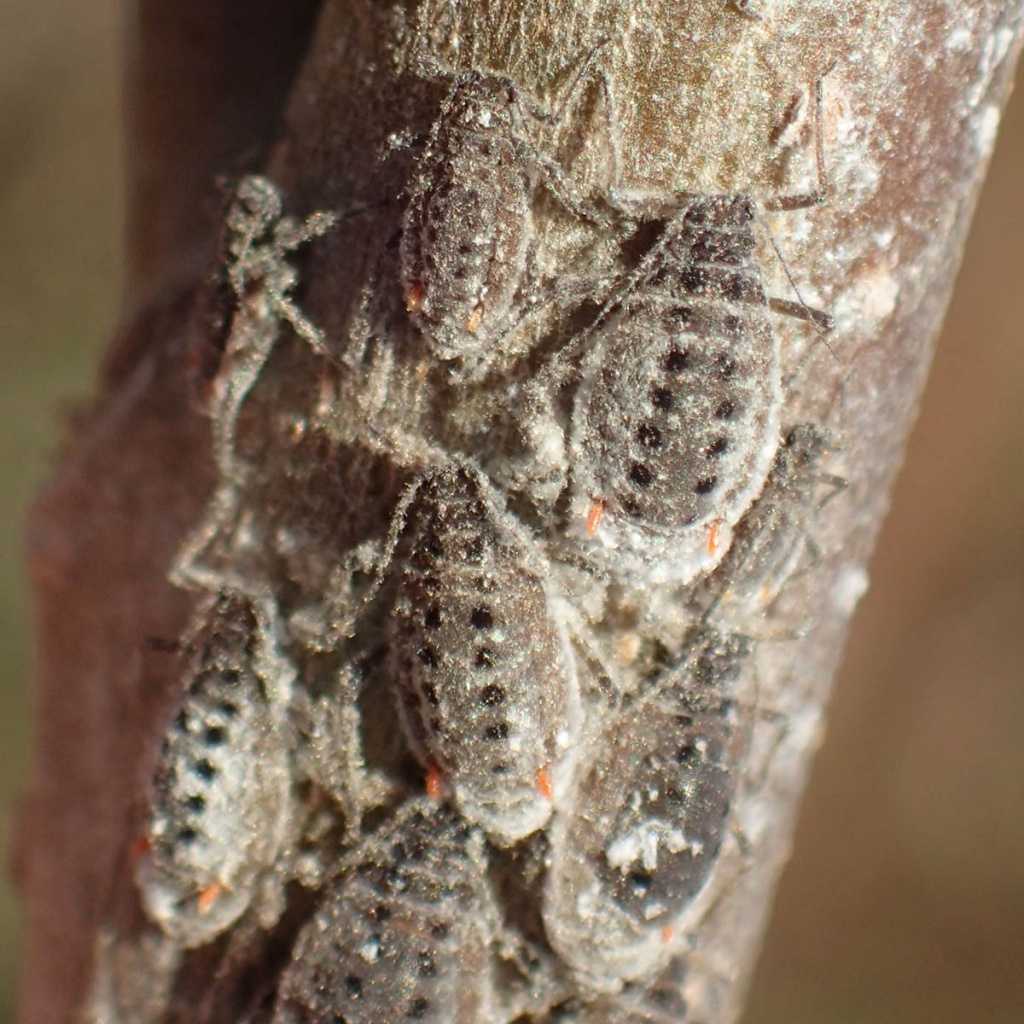
Plocamaphis flocculosa
The aphid Plocamaphis flocculosa y feeds on the branches and trunks of some Salix species such as Goat Willow and Grey Willow. The aphids are large and mainly grey coloured measuring 3.1 to 5.0 mm in length. The head and legs are dark and there are two rows of dark spots running down the back. The insect is almost completely covered in whitish wax secretions. The siphunculi are bright orange.
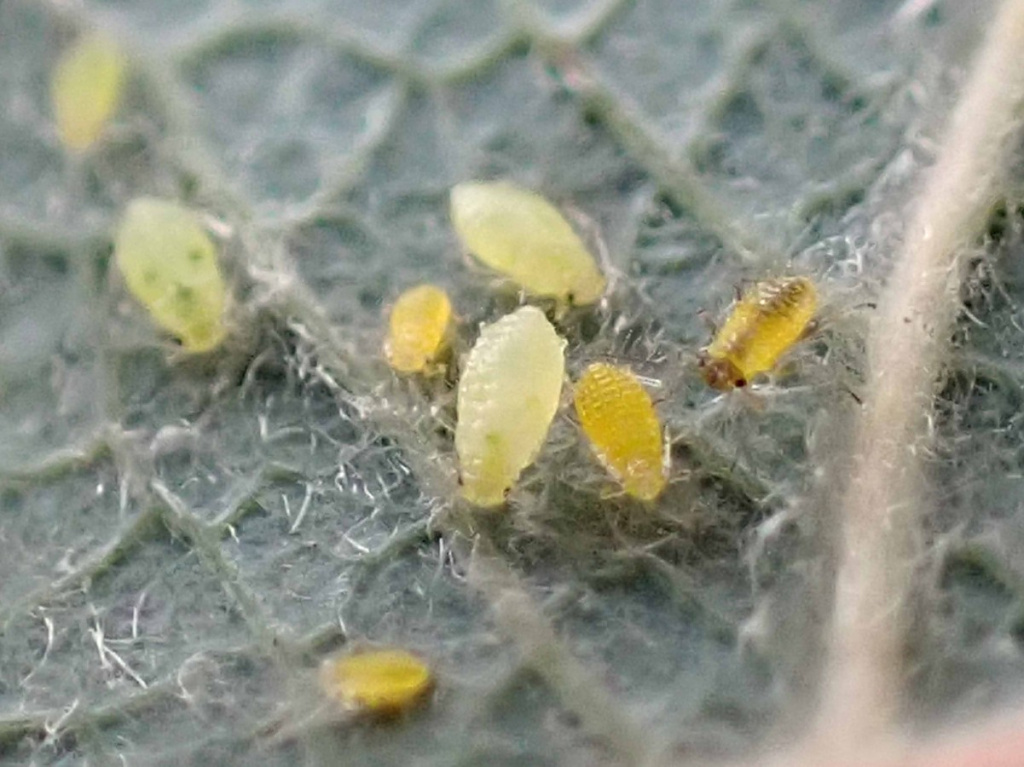
Chaitophorus capreae
The aphid Chaitophorus capreae is usually found on the underside of the leaves of Goat Willow or Grey Willow. The apterae are white to yellowish-white or bluish-green with no distinct dark dorsal abdominal markings. In autumn, the small, bright yellow males with dark antennae are distinctive.
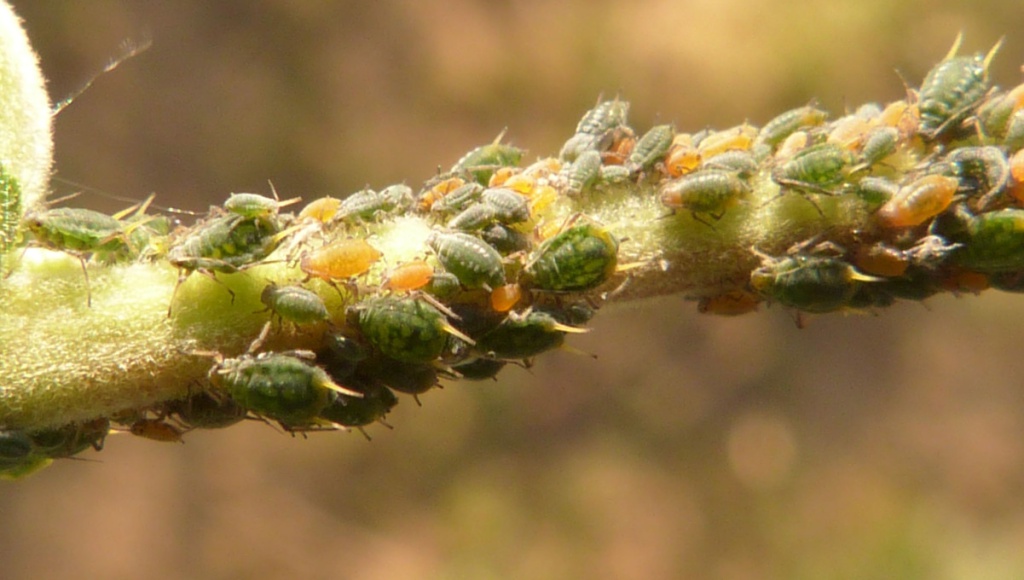
Small Willow Aphid
Small Willow Aphid (Aphis farinosa) feeds on Willows (Salix spp.) especially Goat Willow and Grey Willow. The apterae are quite small and are green mottled with yellow-orange. The siphunculi are pale with a slightly dusky tip and the cauda is distinctly darker. The body length of Aphis farinosa apterae is 1.6 to 2.5 mm. Their oviparae are dull green and the young nymphs and the apterous males are reddish orange. The alates are dark green, and their siphunculi are more or less dusky.
%20near%20library%20%20Sapcote,%20Leics.%20Grid%20ref%20SP4890%209322%20(taken%2025.9.2008),.JPG)
Euura pavida
The larvae of the sawfly Euura pavida feed on various willows. They have a black head with a yellow collar and the body is greyish green with three, more or less solid, parallel lines running down the back for the length of the body, and below these a series of black spots.