

Rabdophaga salicis
The larva of the gall midge Rabdophaga salicis forms galls on certain Sallow and Willow species (Salix sp.) including Creeping Willow, Eared Willow, Grey Willow and Goat Willow. The gall is a smooth, globular or spindle-shaped swelling, usually on a twig or stem, sometimes several together and sometimes coalescing.
The galls contain several larvae or pupae in separate chambers. The galls are usually at least 5mm wide and the larvae feed on the pith inside the gall. The gall occasionally occurs on the petiole, midrib, or side veins of a leaf.
Several other species of Rabdophaga form similar galls on Sallows and Willows.
An Agromyzid fly, several sawflies (Euura species), beetles and moths also form galls in twigs and stems of Sallows and Willows; these are generally woody
Gall  Adult
Adult
Open the gall to check for midge larvae. Ensure you have identified the willow or sallow correctly and note the species in your comments. There is guidance here: https://www.naturespot.org/family/salicaceae
Wherever the host willow species occur, usually in damper areas.
Galls are usually encountered on late summer or early autumn.
Galls contain pale orange larvae.
Widespread in Britain, though not particularly well recorded.
Status in Leicestershire and Rutland not known.
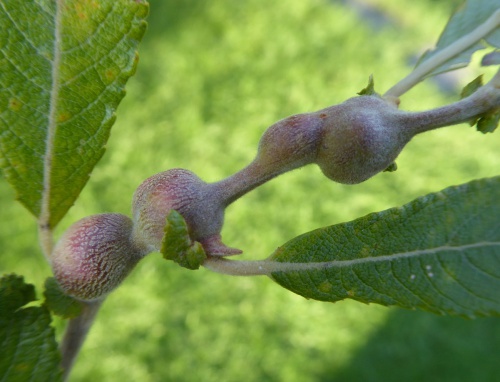 sue
sue
Albert Village lake
21 September 2019
galls on grey sallow twig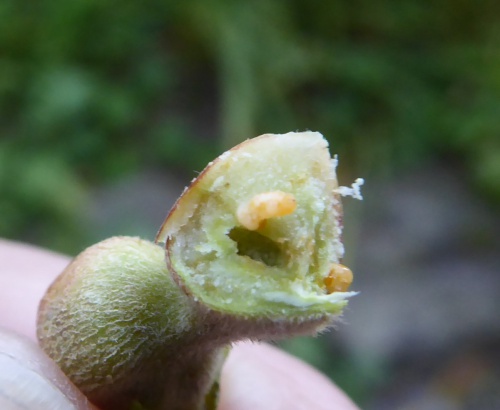 sue
sue
Albert Village lake
21 September 2019
pale orange larvae


Leicestershire & Rutland Map
Enter a town or village to see local records
MAP KEY:
Yellow squares = NBN records (all known data)
Coloured circles = NatureSpot records: 2025+ | 2020-2024 | pre-2020
UK Map
Species profile
- Species group:
- insect - true fly (Diptera)
- Kingdom:
- Animalia
- Order:
- Diptera
- Family:
- Cecidomyiidae
- Records on NatureSpot:
- 3
- First record:
- 21/09/2019 (Timms, Sue)
- Last record:
- 30/01/2022 (Bell, Melinda)
Total records by month
% of records within its species group
10km squares with records
The latest images and records displayed below include those awaiting verification checks so we cannot guarantee that every identification is correct. Once accepted, the record displays a green tick.
In the Latest Records section, click on the header to sort A-Z, and again to sort Z-A. Use the header boxes to filter the list.