

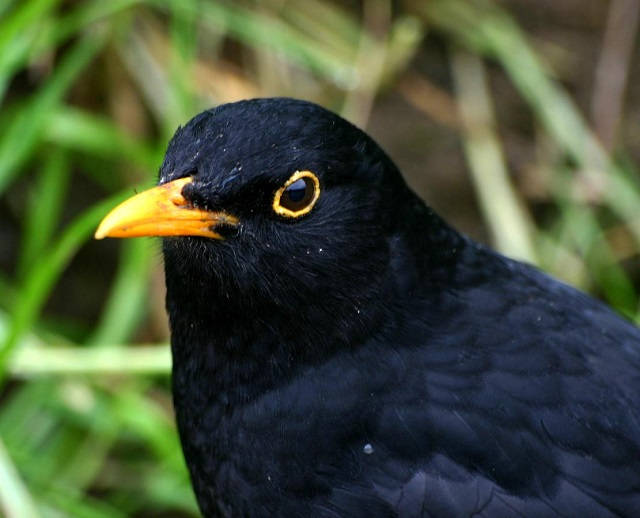
Seen many Blackbirds lately? Has a new virus killed lots of them off? More...
As members of the Leicester Lit and Phil Natural History Section set off on a field trip at Knighton Park in December, two of our number made the gloomy pronouncement that we shouldn't expect to see any Blackbirds (Turdus merula) on the visit, as they have been hit by Usutu virus, a mosquito-borne infection that is impacting the Blackbird population in the UK, particularly the south-east. What is Usutu Virus? How can you help? And did we find any Blackbirds in Knighton Park?
Many people will have heard of some of the diseases that can affect birds. Avian Influenza, which mainly affects sea and water birds, has received a lot of news coverage, especially when it infects farmed birds. You may also have heard of Trichomonosis in European Greenfinches (Chloris chloris). Trichomonosis is a deadly parasitic infection (Trichomonas gallinae) spread through contaminated food, water, and saliva, causing throat lesions that prevent swallowing, leading to starvation.
Usutu Virus (USUV) is a flavivirus found in parts of Africa, the Middle East and Europe. It is transmitted by the bite of an infected mosquito, and it is spreading north through Europe, probably as a result of climate change. It mainly infects Culex mosquitoes and birds, and can be transmitted to humans, though humans cannot pass it on. It was identified in 1959 and named after the Usutu River in South Africa; it was first found in Italy in 1996 and London in 2020. USUV is highly pathogenic in birds, causing inflammation and enlargement of organs such as the liver and spleen and affecting the central nervous system. Infection in humans normally causes no more than a fever and skin rash.
The British Trust for Ornithology (BTO) has run a project to monitor Blackbird populations through garden surveys in 2024 and 2025. As with the decline of species like House Sparrows (Passer domesticus) in recent years, having data about populations is important to understand the spread of the disease and its impact. The 2025 survey is now closed, but keep an eye open for a repeat in 2026.
The Royal Horticultural Society suggests things you can do to help, which include reducing standing water in gardens, such as open water butts where mosquitoes can breed, good hygiene in bird baths and feeders (which helps reduce diseases such as Trichomonosis and Avian Pox), reporting dead birds to Garden Wildlife Health and taking part in surveys such as the BTO's.
You can record Blackbird sightings in NatureSpot, though be aware that during the winter, the UK population is supplemented by thousands of birds that come across from Europe in the same way as Redwings (Turdus ilacus) and Fieldfares (Turdus pilaris). This is why the BTO survey runs during the breeding season from April to September.
And did we find any Blackbirds in Knighton Park? Yes, we saw or heard two individuals flying away from us and making that distinctive scolding call. So there are some blackbirds in Knighton Park still.
We were also pleased to see a Raven (Corvus corax) flying over the park.
(Photo: David Nicholls, NatureSpot)