

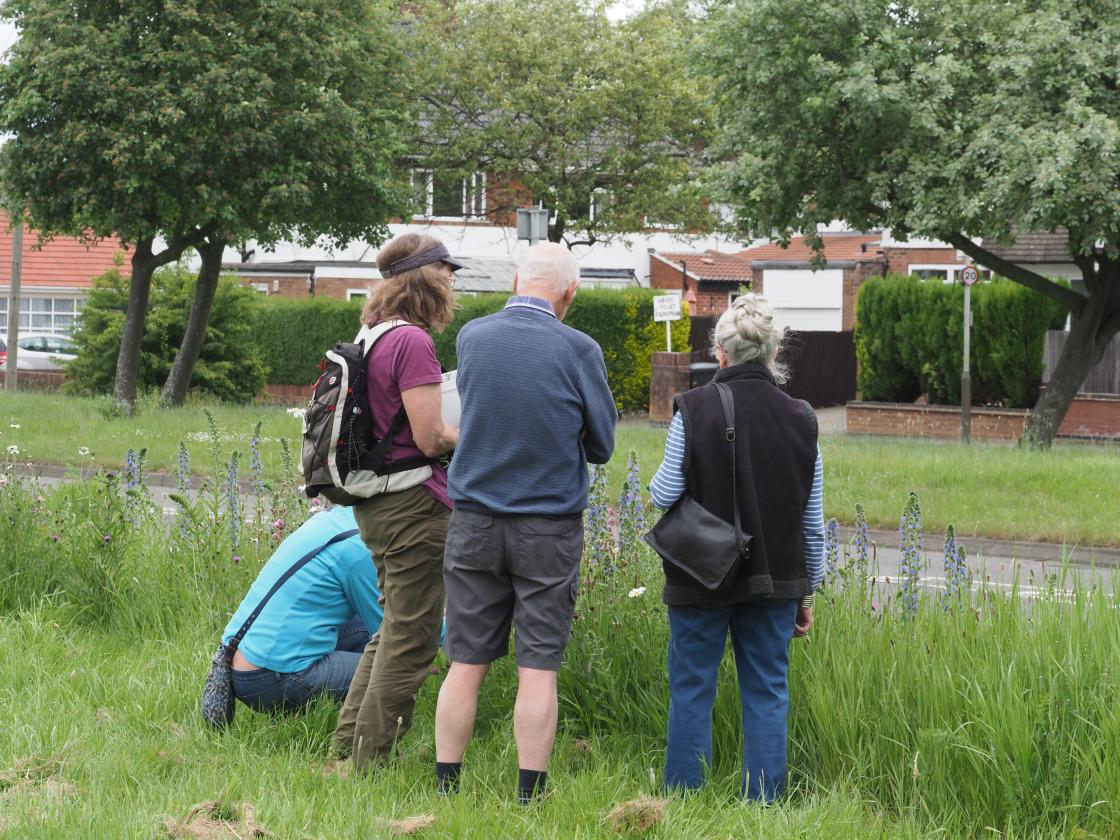
If you'd like to learn, or improve, your identification skills this summer, join one of the free training outdoor workshops run by NatureSpot and supported by the County Council. These courses are aimed at those with little previous experience of plant and invertebrate identification, though those with more knowledge should also benefit. Book now!
Each course will comprise an online introduction (of around an hour) and an on-site workshop (of around 2 hours). The online sessions are recorded so can be viewed at your own convenience but we recommend that you watch them in the week prior to any workshops you are attending. If you would like to attend any of these courses, please contact: Roseanna Burton: Roseanna.Burton@leics.gov.uk
Wildflowers on Road Verges - Led by: Russell Parry and David Nicholls
2pm Sunday 11th June, meet at Goodwood Road/Gifford Close, Leicester SK62880325
You will learn to identify the 45 species of wildflowers most commonly found by NatureSpot during the recent surveys of road verges in the biodiversity project. You will be shown how to recognise the key features which identify each species. An illustrated guide to all of these species will be provided.
Introductory video (recorded)
Grasses on Road Verges - Led by: Russell Parry and David Nicholls
2pm Sunday 25th June, meet in the Evington Park car park (off The Common) SK62530304
Street parking is available on Gifford Close. You will learn to identify around 20 of the grass species most commonly found during the recent verge surveys. A simple key will be provided and you will be taught how to use it.
Introductory video (recorded)
Wildlife on Road Verges - Led by: David Nicholls
2.30pm Sunday 2nd July, meet at 2pm Ferndale Drive, Ratby SK51820577
Parking available at Ferndale Play Park or on-street along Ferndale Drive. This course will look at the many wildlife species that are commonly found on grassland verges. This will include the invertebrate species most commonly found during the recent verge surveys and help you to recognise first the group type and then the species. Illustrated ID guides will be available.Introductory video (recorded)